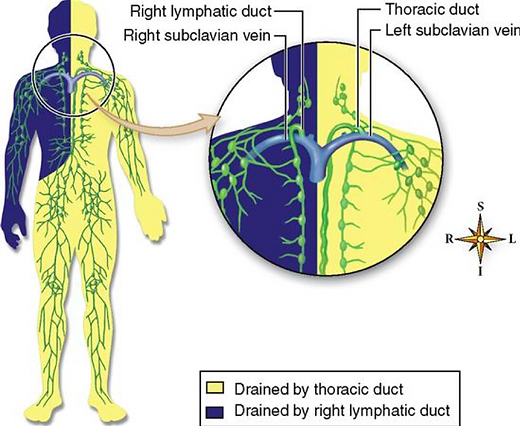
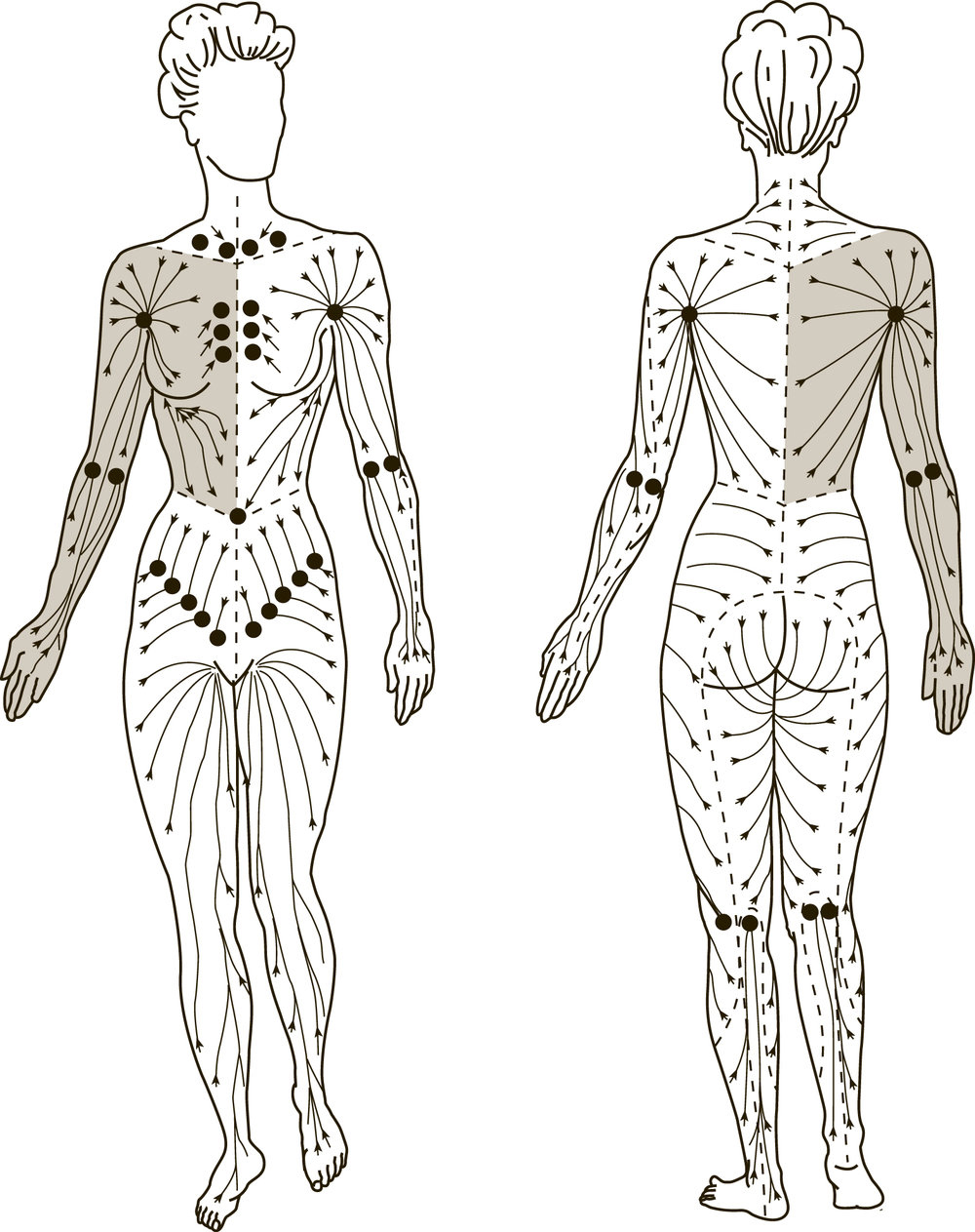
A Watershed is an imaginary line that divides the body and the Lymphatic System into quadrants. Each quadrant has its lymphatic liquid collection canal, and the lower quadrants, as per the two legs, sends the liquid to the cisterna kili, a gland that sits deep behind the belly button that is connected to the upper left duct within the upper left quadrant. Some genetic variation, seeing the thoracic duct connecting to the right lymphatic duct. What does the watershed division look like? The main watersheds are four. A vertical one divides the body into two equal vertical halves. A horizontal one divides the body into the upper and lower body at the inguinal level. Other horizontal watersheds are parallel to each other and are located at: The clavicle line runs through the belly button on top of the iliac crest. In doing so, we have six quadrants: upper, medial, and lower. Other watersheds run vertically within the body. Those are located on the arms and on the upper leg. The importance of watersheds. As we dig more and more within the functionality of the Lymphatic System and MLD as a Lymphatic Drainage technique, we can see that in these specific quadrants, there are bundles of Lymph nodes that get loaded from the lymph vessels connected to them. The watershed division allows the liquid to be directed to a specific body area where lymph nodes are found. Indeed, the lymph nodes are the ones that clean up the lymph fluid, also called obligatory lymph load. When we treat a patient, we have to make sure where we direct the liquid because we want to ensure that the lymph fluid gets sent to the lymph nodes, where it will be processed and then transferred to the lymph/vein duct at the base of the cervical area. This is extremely important when we treat Lymphoedema, where we may bypass the watersheds, where the lymphatic system has been damaged or is missing, to transport the lymphatic fluid from a stagnant area to an active one. How to bypass a watershed To bypass a watershed and transfer the lymphatic fluid from one side of the body to the other side, we have to stimulate the anastomoses, which are the alternative pathways of the lymphatic system. Unless those pathways are stimulated, we can not transfer the fluid side to side along the horizontal or vertical lines. An example would be a person who went through a mastectomy and has a unilateral Lymphoedema. In that case, we need to stimulate the upper anastomosis to transfer the fluid side to side. In the drawing beside, you can notice the upper anterior and posterior anatomoses drawn in thick green lines. The upper watershed and the duct. After the obligatory lymph load reaches the upper watershed (the one running along the clavicle), it gets passed to the venous system. This happens after the obligatory lymph load travels with the trunk collector and passes through the duct. The duct is the last portion of the lymph trunk that connects to the venous system. In conclusion, we want to specify that the lower quadrants (R leg and L leg) and the upper L quadrant drain in the L thoracic duct within the L subclavian vein. Where the R upper quadrant drains into the R duct connected to the R subclavian vein. Below here, is a list of blog posts that talk about conditions where MLD can be beneficial: Bone fracture Sunburn Preeclampsia TMJ Chronic Pain Fibromyalgia Melbourne Massage and Treatment and Lymphatic Drainage Massage At Melbourne Massage and Treatment, Lymphoedema Clinic, I am specialised in Applied MLD and Lymphoedema management. I did train with the Vodder academy for my Lymphatic Drainage practice, and I have a clinical approach to this type of work. If you are in need of manual lymphatic drainage treatment, do not hesitate to book your next appointment now. A 15-minute Online free consultation is also available for those who suffer from Lymphoedema or Lipedema.
Tag Archives: pain
Blog
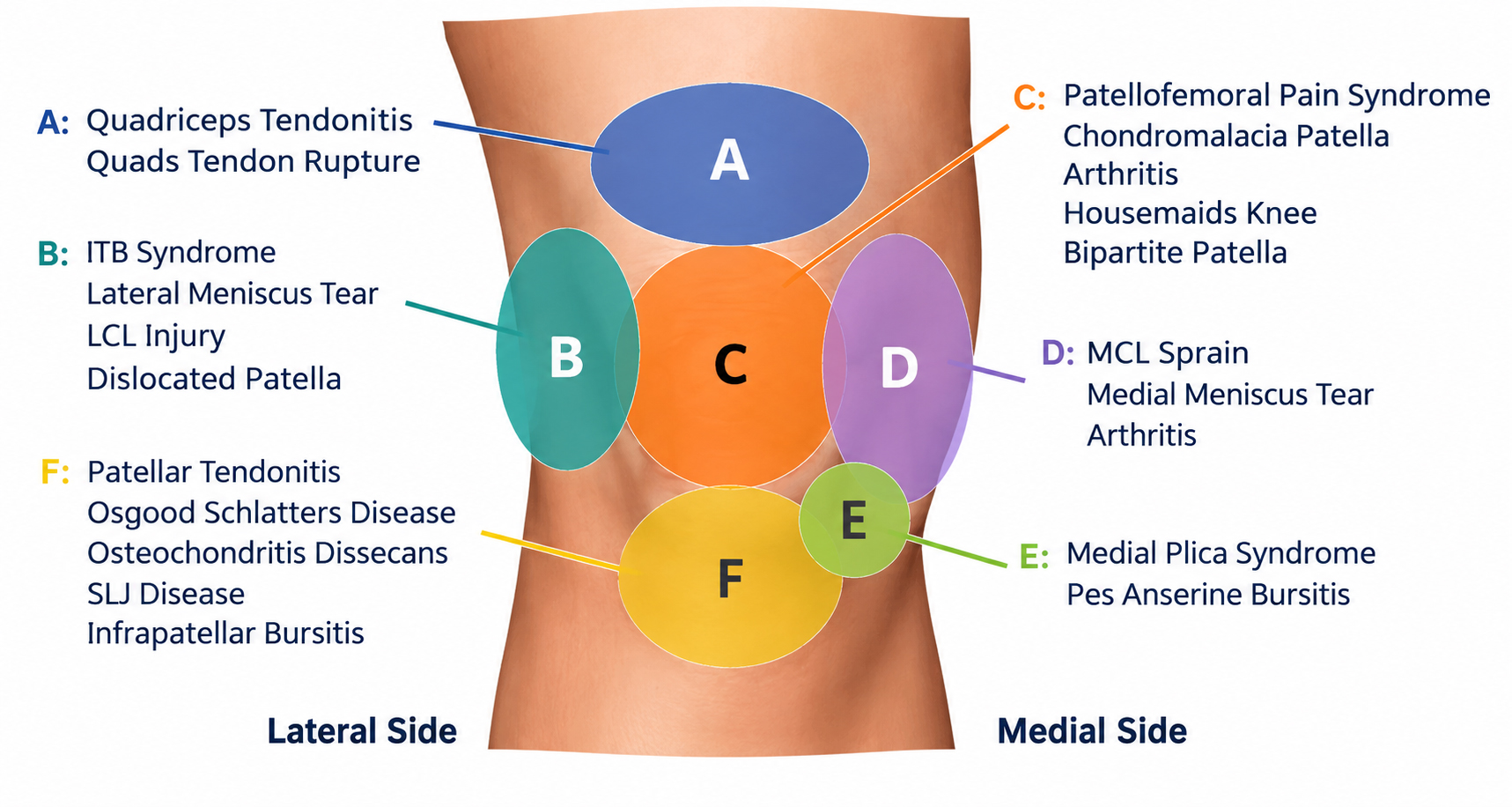
Knee Pain in Coburg
Knee pain is a common form of injury and can affect people of all ages [...]
Continue readingSep

Blog
Post-Surgery MLD Melbourne – Vodder MLD Therapist
Any form of surgery is an invasive procedure for the body to deal with, and [...]
Continue readingSep
Blog
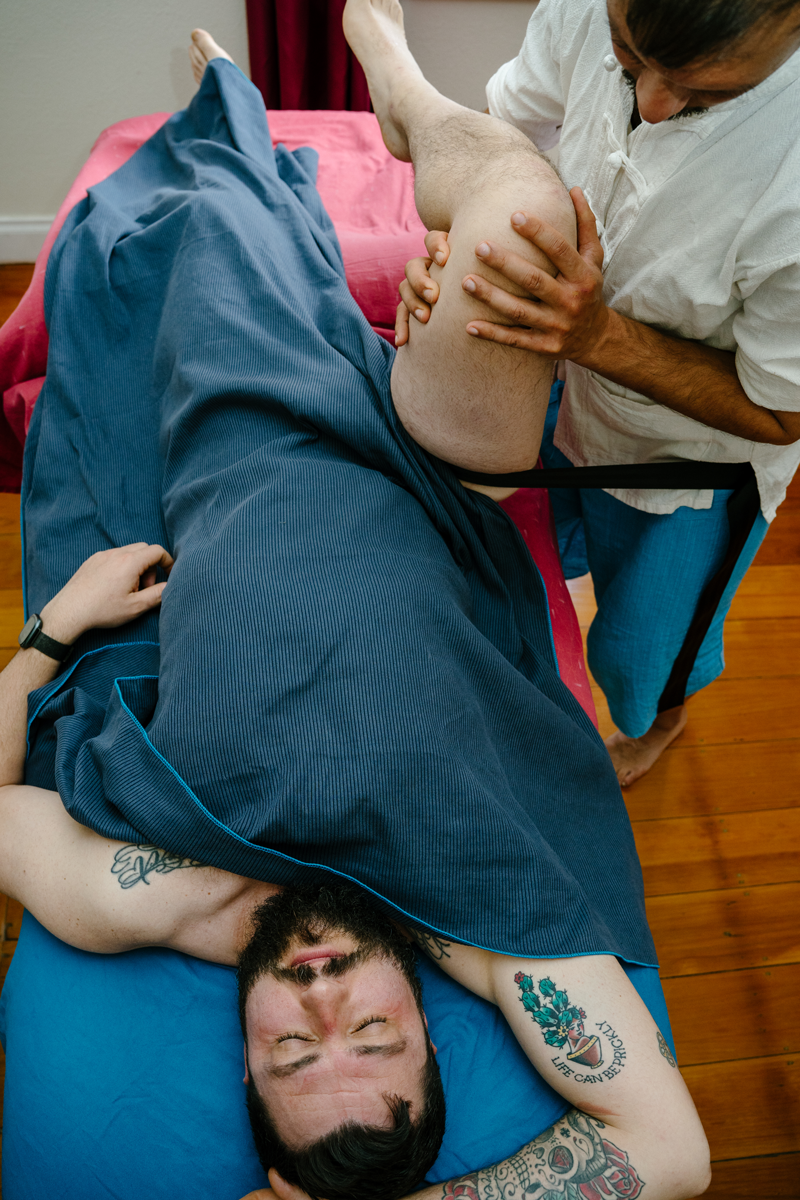
Hip Pain in Coburg: Causes, Symptoms & Treatment
In the many presentations I get to see here at Melbourne Massage and Treatment in [...]
Continue readingSep

Blog
Lymphatic Walking: Let Me Tell You Why It Is Another Trend
Lymphatic Walking is another trend that you really don’t need to overthink. But let me [...]
Continue readingAug
Blog
Shoulder Pain in Coburg: Myotherapy Can Help You
Shoulder pain is a common presentation I get to see and treat here at my [...]
Continue readingAug
Nov
MLD stands for Manual Lymphatic Drainage. As per a deep tissue massage, MLD treatment works on the lymphatic system and not the musculoskeletal system. This technique aims to boost the capacity and ability of the lymphatic system. Manual Lymphatic Drainage history. MLD is a technique implemented by Dr Vodder and his wife, Estrid Vodder, with the help of many other scientists and researchers. Dr Vodder can be described as a visionary of the lymphatic system role. He dedicates his life to the realisation of this technique. Dr Vodder and his wife formulated a series of hypotheses on how the lymphatic system works, and how it is essential to speed up recovery from diverse conditions. All their hypothesis, along the 20th century, were then confirmed and transformed in theory thanks to the works of many other scientists. As per result, after their first few years of hypothesis formulation, in the early 20th century, they could start promoting their work and run seminars and classes about MLD all around Europe. Nowadays, is in Austria in the village of Walchsee -Tyrol -Austria resides the Dr Vodder Academy –Lymphedema Clinic Wittlinger. The Austrian clinic was founded in 1971, and since that, the MLD spread all around the world, with courses that are taught in any continent. The Lymphatic System. To understand the importance of this technique, let’s analyse the body’s anatomy and the lymphatic system’s role. Indeed, for doing so, let’s compare the lymphatic system with the blood circulatory system. Firstly, the lymphatic system is an open system of “capillaries” (lymph vessels) and “veins” (pre-collector and collectors). Secondly, It differs from the blood circulatory system as it transports lymph, not blood, and is open and not closed. Thirdly, the lymphatic system doesn’t have a pump, as is the heart for the circulatory system. In fact, the lymphatic system, pushes the lymph around through a mechanism of osmosis pressure (at the lymph vessels system) and throughout an inner system of inner valves. Furthermore, the lymphatic system has filtering stations: lymph nodes. It is here where specific white cells live. Indeed, the role of the white cells is to help fight back infections carried by viruses and bacteria. Said so, the lymphatic system’s primary role is to collect waste. This happens at two different levels. At the superficial level (80%), where the lymph vessels are (lower dermis and the superficial zone of the subcutaneous tissue) and deep level of the body (20% below the deep fascia) return this waste to the blood system will then direct all the waste to the organs that clean the body, such as liver, kidney etc. How the lymphatic system works. So, our body is covered in skin, right? Below the skin, before the fascia and muscle layers, we got lymph vessels (the equivalent of capillary for the blood system). The lymph vessel spread on a vertical level all along the body in different concentrations. As per role, the lymph vessel collects the Lymph-obligatory load, the waste and excess material the body doesn’t need. Lymph-obligatory load is made from water, protein, lipids, exogenous substances, cells etc… The collection of the lymph-obligatory load comes through a suction and osmosis approach. The lymph obligatory load travels down to the pre-collectors from the lymph vessel. Indeed, pre-collectors are slightly more significant than the lymph vessel Furthermore, rather than spread along the undersurface of the skin, they travel deep down and pass the lymph fluid to the collectors. As per result, the collectors that interconnect the lymph nodes transport the lymph-obligatory load to the blood circulatory system. Another specification to look for is that the lymphatic system is divided into superficial and deep. But we will look at this specification in the next blog post, where we will also talk about the watershed and body quadrant. Manual Lymphatic Drainage compared to the massage technique. So, now that we have a better idea of what the lymphatic system is and how it works, we can say that massage techniques such as Myotherapy, Thai Massage, Remedial Massage, or even Relaxation Massage are not the most indicated for helping the lymphatic system. They still would improve its work, but as the lymphatic system sits right below the skin and works by light stimulation, the friction and pressure applied with these techniques would be too strong. Even though no damage occurs to the lymphatic system when significant pressure is applied to it.
Nov
In this post, I talk about Remedial Massage and how this technique is applied in my services. What is a Remedial Massage? How does it work? Where did I train for this type of massage? As per the name, remedial massage aims to improve the quality of life of the clients, by giving a remedy to her/his physical disconfort/s. So, to start with we describe the difference between a remedial massage and a general relaxation massage. Indeed, a relaxation massage is a combination of soft and deep strokes. Therefore, those strokes are applied using oils. A relaxation massage aims to stimulate physical and mental relaxation by pushing the blood and body fluids around the body. In regards to the remedial massage, the therapist, before the massage will go through a complete assessment of injuries and or musculoskeletal conditions. As per result, the therapist creates a comprehensive treatment plan to manage or rehabilitate the injuries or pain. Indeed, a remedial massage would speed up the process of healing and recovery. In conclusion, at the end of each session, the therapist would demonstrate and provide the client with corrective exercises that can support the client’s wellbeing and recovery. About my training for remedial massage, I did study at the RMIT University, here in Melbourne. In 2020, the world stopped because of Covid-19 I took the occasion to quit my previous job and get back to studying massage. I don’t regret my choice. Indeed I will keep studying in 2022, for the advanced diploma in Myotherapy. I want to keep learning and improving my massage skills and knowledge, to offer always a better service. Said so, I will keep offering Thai Massage as a massage service too. In fact, as I already mentioned in another blog post, the technique that I work with is not so demanding on my body. In fact, it allows me to enjoy more what I do and allows the client to receive a better level of healing. True fact is that the client after a Thai Massage session, here at Melbourne Thai Treatment, told me always how they feel lighter, better, less stressed and more aware of their body feels. In the next blog post, I am going to talk about the strokes that we use in Remedial Massage and how I implement those strokes in Thai Massage.

Oct
What is Fascia? Why is it so important? How does it work? How can Thai Massage help improve fascia mobility? A fascia (from Latin: “band”) is a band or sheet of connective tissue, mainly made of collagen, that sits below the skin and attaches to, stabilises, encloses, and separates muscles and other internal organs. Firstly, fascia can be classified by layers: superficial, deep, visceral, or parietal or by its function and anatomical location. Like other body parts, such as ligaments, aponeurosis, and tendons, fascia is made from fibrous connective tissue. In addition, these connective tissues contain bundles of collagen fibres oriented in webby patterns, parallel to the direction of pull. About collagen fibres, they are produced by fibroblasts, contained within the fascia. In conclusion, fascia differs from other body components such as ligaments and tendons.This is because ligaments hold bones together, and the tendons attach the muscles to the bones. Going ahead we can define F. based on its location and Superficial F. This is found just below the last skin layer, the subcutis, in most regions of the body, blending with the reticular layer of the dermis. Muscular F. Defined as the fibrous layer surrounding the muscle, or other body parts such as nerves, bones. Visceral or parietal F. This type of structure suspends the organs with their cavities and wraps them in layers of connective tissue membranes. In regard to the functionality of the F., we look into the ability of this tissue to allow the muscle to move freely. If this post is talking to you and you are in need of a massage, book your next session by clicking here. So let’s imagine this really thick web, sitting between the skin and the muscle and around the muscle too. If the web is overconnected, that means it is tight, and the muscle would find it difficult to move and slide. The same would happen for tendons and organs that need to function by being able to move freely. For example, it does often happen to see customers that when asked to flex the shoulder, as they bring the arm over the head, past the 90° point, there is noticeable dragging in the fascia along the anterior and/or posterior and/or lateral thoracic area. The person, unless told to feel what happens in the thoracic area, would hardly be aware of any restrictions in the thoracic area. Having said that, we can now open a Pandora’s box and talk about the fascia lines. Fascia lines connect the body side to side in the long, for the horizontal and diagonal directions. As per the example, we have an F line that travels from the foot to the head. Indeed, this F line starts from the Fibularis M, going up for the IT Band, into the TFL, Obliquos Abdominal muscles, opposite Serratus Anterior, Rhomboids, and finally to Splenius Capitis.As a result, someone who suffers from flat feet, and so has Fibularis M, under constant pulling force, may experience shoulder pain on the same side of the body because of Fascia restrictions. But there are more F. lines than the diagonal ones. In fact, we got a Superficial F. line, Functional F. line and Lateral Lines. So, lastly, how can Thai Massage help? Thai Massage can help with stretching the fascia by applying a force on the skin in the direction of the restriction. It is enough to check in which direction the skin feels tight, and that’s the direction in which we want to apply a stroke with a pulling force, strong enough that the client does actually feel a stretch. At Melbourne Massage and Treatment, I use techniques of work like MFTT and/or Cupping and static/dynamic stretching. In regard to cupping, add MFTT, which is a technique of work that I did learn at RMIT along with my studies for the Diploma in Remedial Massage. The static/dynamic stretch, indeed, is part of the techniques used along with the Thai Massage. In conclusion to this blog post, I would like to invite you to see this video from Dr Gil Hedley, which dives into the magnificence of Fascia.

Oct
Functional test and the empty can test. What is a functional test? What is an empty can test and how does it work? Firstly, functional tests are used to test the strength or load capacity of a single muscle. Secondly, the importance of a functional test is due to avoid misinterpretation of the muscle status and joint health conditions. Furthermore, functional tests can be positive or negative. So, for positive, we refer to a test that gave us the result we were suspicious of. For example, if I do an empty can test, and the client during the test complains of pain in the shoulder acromion, the test is positive. But if for instance, the client complains of pain in another area of the shoulder or arm, the test is negative. Even so, as a therapist, we are aware that other area of the arm or shoulder needs to be looked after. What is an “empty can test”? An “empty can test” is a functional test used to validate the state of health of the supraspinatus tendon, at the high of the acromioclavicular joint. In addition, to better understand how this specific test works, let’s look in too the anatomy of the Supraspinatus m. Origin: Supraspinatus fossa of scapula Insertion: Greater tubercle of the humerus Action: Abduct the shoulder and stabilise the humeral head in the glenoid cavity. As per result, the action of the supraspinatus is to laterally elevate the arm and hold in place the humeral head (the Humerus is the bond of the upper arm). Furthermore, the supraspinatus is one of the rotator cuff muscles. The rotator cuff muscles are: Supraspinatus, Teres minor, Infraspinatus and subscapularis. But let’s get back to the empty can test. The empty can test can be done from seated or standing. In addition, the test is conducted in 2 different stages. Initially, we will ask the client to bring the arm in flexion at about 45° and in abduction at 45°. The arm now is sitting aside from the client’s body, on a diagonal line. Now will ask the client to rotate the arm on itself, as if they are emptying a can. As per the result, if at this stage of the functional tests, the client feels pain in the shoulder at the acromioclavicular joint, the test is positive. If that’s not the case, then we can proceed with the resistant part. If this post is talking to you, and you are in need of a massage, book your next session by clicking here. The resistant part consists of placing our hand on the client’s forearm and asking the client to meet the resistance, at 3 different stages. For each stage, the resistance increases and lasts from 3 to 5 seconds. If during any of the 3 stages the client feels pain, at the high of the acromioclavicular joint, the test is positive. But why the client can feel pain during this type of functional test? To answer this question, we have to look in too the acromioclavicular joint anatomy, but I will talk about this topic in the next blog post.

Oct
Firstly the Cervical Occipital muscles are a group of muscles, that seat inferior to the skull and are bilateral to the first and second cervical vertebrae. Cervical Occipital muscles are responsible for 45° of rotation out of 90°. Along with these muscles we find: – Obliquus Capitis Inferior; Origin: Spinous process of Axis (C2) Insertion: Transverse process of Atlas (C1) Innervation: Suboccipital nerve – Obliquus Capitis Superior Origin: Transverse process of Atlas (C1) Insertion: Superior line of Occipital bone Innervation: Suboccipital nerve – Rectus Capitis Posterior Major Origin: Spinous process of Axis (C2) Insertion: Inferior line of Occipital bone Innervation: Suboccipital nerve (posterior ramus of spinal nerve C1) – Rectus Capitis Posterior Minor Origin: Spinous process of Atlas Insertion: Inferior Line of Occipital bone Innervation: Suboccipital nerve The actions supported by Occipital Muscles are to extend and rotate the head. How tight Occipital Muscle affect ROM. When rotating the head, so looking at your right or left, you may notice that you don’t have a full range of 80° to 90°, and you start rotating with the thoracic too. One possible reason for this is tension at the occipital area, due to muscle tension and or facet joint irritation. Moreover, to the rotation and extension actions the Cervical Occipital Muscles, are responsible for holding the head up straight. This characteristic is to be taken into consideration with the anti-gravity functionality. In addition to the Cervical Occipital Muscles, other anti-gravitational muscles are the Soleus, Quadriceps Femoris Group, Gluteus Max, and Erectors Spines group. The anti-gravity functionality is essential for the body to fight back gravity (9.81 m/sec2) and allows the body to stand straight up. This group of muscles received information in regard to the gravity pressure from the feet. This information travels along the nervous system starting from the Center of Gravity (COG) of the feet. If the COG is not balanced all body gets affected with a loss of balance as per result. Furthermore, in modern days, the Cervical Occipital Muscles are under constant stress as per all the other anti-gravitas muscles. This is due to spending long hours standing or seating. For example, standing for long hours would overload the feet, leg and back muscles, whereas seating would inhibit the leg muscle but overload the back and cervical muscles. On top of that, spending long hours looking at the phone and or PC would additionally put stress the Cervical Occipital Muscles muscles, as they get over-stretched. How massage can help? As per massaging this area, as therapists, we look into avoiding the Suboccipital triangle, which is defined by the border of the OCI, OCS, and the RCMaj. The Suboccipital triangle is an endangerment site. This means contains superficial, delicate structures that are relatively unprotected and therefore prone to injuries, such as the Vertebral artery, Suboccipital nerve (C1) and Suboccipital venous plexus. If this post is talking to you, and you are in need of a massage, book your next session by clicking here. And what about exercises? As per all the muscles of the body, there are exercises that can be done for the Cervical Occipital Muscles. Along with Thai Yoga, I teach a really simple exercise that recalls the Scap Off Load Test ( a Functional test used to determine what muscle of the cervical region may affect the head rotation). Firstly, in this exercise, available in the Melbourne Massage and Treatment YouTube playlist, you are seating on the floor with a cross leg (a yoga block or pillow can be used as per support), hands projected backwards, with wrists seated below shoulders on a straight line. As per result, the neck would seat in between the shoulders. Secondly, by flexing the head forward, reach the manubrium (the bond that connects the clavicles) with the chin, and with a gentle rotation movement, start rotating the head in a circular movement. Indeed per many Thai Yoga exercises, it is important to be aware of the movement, the body sensation and the speed of movement, which is to be slow and weighted out.

Sep
Scoliosis is a sideways curvature of the spine that most often is diagnosed in adolescents. Firstly, let’s say that there are 2 main types of scoliosis: Functional and Structural. Indeed, Functional S. is a type of scoliosis due to a muscular unbalance in the body. The spine presents a curvature but no rotations. On the other hand, Structural scoliosis is due to a structural abnormality, like a bond deformation along with the skeleton and it diverges from a functional S. due to rotation in the spine, and not just a curve. Said so, to diagnose the differences between functional and structural, we can ask the client to band forwards from a standing-up position, by trying to reach the floor with the hands. As the client band forward, if there is torsion in the torso, that’s a sign of structural scoliosis. About 80% of scoliosis, is structural. There are then different levels of scoliosis: Mild Cobb angle measurement of between 10 and 25 degrees Moderate: Cobb angle measurement of between 25 and 40 degrees Severe: Cobb angle measurement of 40+ degrees Very severe: Cobb angle measurement of 80+ degrees The Cobb angle is the most widely used measurement to quantify the magnitude of spinal deformities, on plain radiographs. Scoliosis is defined as a lateral spinal curvature with a Cobb angle of >10°. Furthermore, the different levels of scoliosis can be defined as: Idiopathic This is the most common type of scoliosis and as it doesn’t reproduce any pain at a young age, it is often missed diagnosed becoming the cause of pain in the adult stage of life. It does affect more women than men. Are you struggling with pain and or body ache? Book now your next massage appointment at Coburg Clinic. Neuromuscular As per the name, in this case, scoliosis is associated with neuromuscular issues. Often it is diagnosed at a young age, and the 2 conditions have to be treated separately. Degenerative As per the name, this type of S. is due to a bond degeneration at the level of the facet joint. As per the result, the symptoms are like: lower back pain, (that’s where most commonly a degenerative facet can happen), sciatica pain, and difficulties in walking. Congenital Congenital scoliosis is a condition that affects a child that is not born yet. As the fetus is forming, one or more vertebrae may fuse together, or bony spinal segments or vertebrae fail to form properly. Traumatic Traumatic scoliosis, as the term already described, can be the result of an accident or a major physical trauma. Like a car accident. Given now a clear explanation of this condition, we are a bit more aware of what a curve in the spine is about. Corrective exercises are the key answer to scoliosis. Physiotherapy is probably the best medical practitioner to refer to for corrective exercises related to this condition. Said so: Q: “I got lower back pain. That means I got scoliosis?” A: “No. Lower back pain is one of the symptoms of scoliosis, but there are several reasons why you may suffer from lower back pain.”

Aug
Muscle Firing pattern Muscle firing pattern is the sequence in which muscle should get activated to complete an action or movement. Whenever we move a joint, is not just 1 muscle to do that action there are multiple numbers of muscles that allow the action to happen, and other multiple numbers of muscles counterbalance that action. So, the muscles that control the action are called agonist muscles and the antagonist are the muscles that counterbalance that action. The antagonists are usually the muscles that do the opposite action to the one played. Said so we have also to introduce another term, that in the massage industry is known as synergetic muscles. Synergetic muscles work together to make allow a joint to complete an action. But let’s look into an example. Leg extension firing pattern. Leg extension is controlled by the synergetic muscle: gluteus max (GM) hamstring (HM erectors spine (Esp o) (opposite side of the leg) erectors spine (Esp s) (same side of the leg) The antagonist in the leg extensions are the Quadriceps. So, let’s focus on the agonist of this action for now. If the GM is weak or inactive, when we go for leg extension the Hm gets overpowered. As the Hm gets overpowered the ES starts firing too early to stabilize the pelvis abandoned from the weakness of the gluteus. Moving forward with this unbalance, the ES on the same side could end up to start being the first muscle that gets fired for doing the action of leg extension when it should be the last one. And this could happen because the Esp o is holding the body still to get the action done. Lower back pain or hamstring tear can be often a consequence of these unbalances. Lower back pain can happen when the firing pattern is like: 1st Erectos Spine (opposite or same side) 2nd Hamstring 3rd Gluteus Max (because if weak or inactive) Hamstring tear can happen when the firing pattern is like: 1st) Hamstring 2nd) Eroctos Spine (opposite or same side) 3rd) Gluteus Max (because if weak or inactive) But nothing is lost, and the firing pattern can be reorganised. For doing that we have to look into exercises for firing pattern reestablishment. For the leg extension, for example, the exercises would be: Lying in a prone position (face down) Tugged the toes under the feet Squeeze the gluteus one against the other With the gluteus, squeeze and extend the knee Still with the gluteus squeezed to release the knee The final step, release the gluteus. Repeat 30 times for 6 weeks every day. To don’t fall back into an incorrect firing pattern, make sure to strengthen the gluteus. Massage would help to release the trigger point in the GM. Thanks to the release of trigger points the muscle can start to be trained to get stronger. Are you struggling with pain and or body ache? Book now your next massage appointment, at Melbourne Massage and Treatment. Also, massage can help in fastening the process of firing pattern reestablishment, by reducing tension in the hamstring and or reducing pain in the lower back by flashing out the tensions that have been accumulated over time.

Aug
Lower Back Pain Lower back pain is a condition which can deliver lots of stress and can affect our daily habits. It can be a terrible experience to live, as it can make many tasks difficult or impossible to take. Here below you will find a series of questions and answers in regard to my experience with lower back pain, as a person and as a practitioner. Q: Did/do you ever experience lower back pain? A: Yes, I did suffer from lower back pain when I was a teenager and that was a trigger for my massage career.Said so, at the age of 16, I was not thinking yet to become a massage therapist.More experience was needed before I did decide to step into the massage career. Q: How common is lower back pain within the Australian population? A: It is estimated that in Australia between 2017 and 2018 4.0 million people did suffer from back pain, whereas 70-90% out of those 4 million did suffer from the lower back itself. Q: What are the causes of Lower back pain? A: Lower back pain can come from different causes. Here below are the most common: bulge disk muscle strain fascia tightness trigger points muscular-skeletal unbalance physical trauma stress Q: I feel pain on my Rx or Lx side on a horizontal line. What can be? A: That’s what we call a red flag. A pain that spread on a horizontal line can be given by a bulging disk. More tests must be put in place to confirm a diagnosis. As a massage therapist is not in our scope of practice to diagnose a bulging disk. Our next step would be to refer you to a GP for further investigations. Q: So, what is a bulging disk? A: A bulging disk is a condition (hernia) where the disk that seat between the vertebrae, gets a tear in it. As a consequence, the disk touches the nerve running along the spine and creates a pain sensation. There are 4 different stages of herniation of the disk. Disc protrusion Prolapsed disc Disc extrusion Sequestered disc. Q: What are other symptoms related to a bulging disk (for the lower back)? A: Other symptoms of a bulging disk (for the lower back) can be: Numbness in the glutes, legs, feet. Weakness in the leg/feet movement Pain increases when seating, like the disk, gets compressed and decreases if standing, like the disk, gets decompressed and less pressure is applied to the nerve root. Difficulties in going to urinate, it is a strong sign that there could be a bulging disk in the lower side of the lumbar area. Medical attention is urgently recommended. Q: Why a bulging disk can occur urine blockage? A: The nerve that controls the spasm of the bladder is rooted between L1 and L2. Indeed, Pressure on the main root, between these 2 vertebrae, would then transform into nerve dysfunction. This condition is called Cauda Equina Syndrome. Q: My lower back pain moves vertically. Why is that? A: A sign of lower back pain that moves vertically is more luckily related to muscular inflammation. In fact, there is a group of back muscle called Erectus Spinae, (Spinalis, Longissimus, Illiocostalis) that originates in the lower side of the lumbar area and extend vertically along the cervical area. Q: What triggers muscle inflammation? A: Many are the reason why muscles can get inflamed.Repetitive movements pour posture, the incorrect firing pattern of a muscle group, in specific the leg extension firing pattern. Q: How massage can help? A: Massage can be an effective approach to release tension along the lower back. Given the training that I did go for, I would ensure to use the knowledge learned along the Remedial Massage and Myotherapy course to identify what back pain is related to. Based on the finding and on the willingness of the clients, we can then disgust with the client what technique of massage they may prefer, Remedial Massage, Dry Needling (if applicable), Mobilisation (if applicable) or Thai Massage. Even MLD can be an effective technique, as it can be used to reduce inflammation, swelling, tension and stress. As previously mentioned, if I got suspicious of a bulging disk, I would not hesitate to refer the client to a GP for further investigation. In regards to the Thai massage technique, I will ensure to warm up the area first with some simple passives stretch and or cupping and then work on the muscle that needs some tension released if it is safe to do so, or on the muscle surrounding the area, like gluteus, hamstrings and or shoulder muscles. Q: Would you use your knee to massage my back? A: The use of the knee is not compulsory. If it is safe to do so, yes, I may use my knee to massage the back. A correct and proper evaluation of the injury must be applied before doing so. If you are in pain or even just feel tight along your lower back, don’t hesitate to book a massage appointment. Any of the techniques offered at Melbourne Thai Treatment can be really effective in reducing pain and ache and giving you back the mobility lost. Said so, for chronic conditions their massage can help till a certain point. Exercises and other treatment options have to be evaluated.

Aug
Exercises for Upper Cross Syndrome As previously mentioned, the UCS is caused by a constant habit of poor posture, to achieve a correct posture on top of massage therapy, we would need to do exercises for Upper cross syndrome. So, there are 2 main groups of muscle that we want to target. 1st group, the tense muscles: Levator Scapulae Upper Trapezius Pectoralis Major Second group, weak muscle Deeper Neck Flexors Rhomboids Middle Trapezius. Now, let’s go through some exercises for Upper cross syndrome. Brugger exercises for Neck deep flexors. This exercise is going to focus on improving the strength of the deep flexors. Stand straight with feet apart ; Place 2 fingers, one on each sternocleidomastoid and start gently and slowly flexing the head forward. The fingers seating on the Sternocleidomastoid (SCM) would allow you to keep those muscles deactivate and so would place all the strength of flexion on the deeper muscle that we are trying to train in gaining strength. If you are not sure where the SCM is, place a hand horizontally between the neck and the upper chest, along the Clavicle line. Rotate your head gently right and left and those 2 muscles that pop up below your hand when you rotate the head are the SCM. Just be aware that the L SCM will activate when you rotate right and vice versa; 3 repetitions for 10 head flexion. Do you feel like you need help with your neck pain? Book now your next appointment at Coburg Clinic. Strengthening the Rhomboids and Middle Trapezius. For this exercise, we would need an elastic rubber band for exercises. · Stand straight, feet apart, and wrap the elastic band on your fist, thumb facing out. · As you breathe in flex the elbow at 90, breathe in and bring the rubber band in tension. As you breathe out extend the elbow out. · Release and start again. 3 repetitions of 10. All those exercises have to be done daily for 6 weeks in order to be effective to change the UCS. Self Massage for Pectoralis/Upper Trap/Levator Scapulae. Pectoralis Self Massage exercises: Lie down in a prone position with the arms along the body; Place a tennis or a spiky ball right between the Pectoralis and the floor; Keep the foot’s toes anchored on the floor; Gently push yourself forward and back by breathing in (from the nose) and out (from the mouth). If you would like more pressure, is enough to open the arm at 90 and lightly extend the arm, by lifting the hand from the floor. Upper Trap and Levator Scapulae Thai Yoga exercises: Start by lying in a supine position and the ball will be seated between the shoulder and the floor. Place the ball right next to the upper angle of the scapula. This time keep your shoulder flexed at 90 degrees, so with the hand facing the ceiling. Start gently a slow rotation movement at the shoulder, by drawing a circle with the hand. 3 series of 6 repetitions for each rotation movement. With Thai Yoga, you wanna make sure that each exercise is done slowly and gently. Those exercises often work on the delicate area of the body and can reproduce massage pain. Moving the body slowly and gently and having constant breathing in and out would allow you to live Thai Yoga at its full potential.