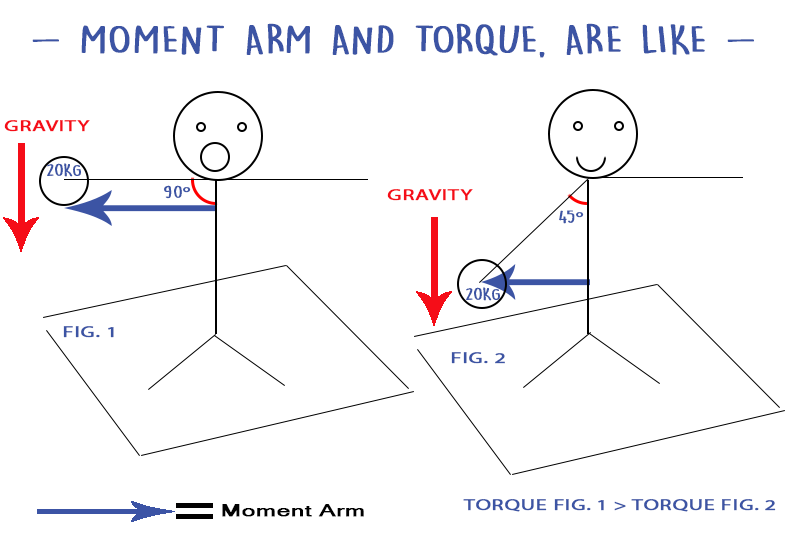
Biomechanics is a branch of biophysics, and it studies the structure, function biomechanics is a branch of biophysics, and it studies the structure, function and motion of the mechanical aspects of biological systems using mechanical methods.d motion of the mechanical parts of biological systems using mechanical methods. Why is Body Biomechanics important? The way we move is a crucial component of injury prevention. Ensuring we are moving using our advantage, forces like gravity and body weight can help us reduce the chance of injury and improve the load capacity. To do so, we must train with a specific protocol that ensures excellent mobility to achieve muscular strength. What is a force? We can define a force as an influence that can change the motion of an object. Gravity is an acceleration that becomes a force when applied to a body. This concept was well explained by Netwon, with the announcement of Newton’s second law that can be summarised with F=m*a. F is the force, m is the mass, and a is acceleration. In the case of acceleration of gravity, it does measure 8.91 m/sec2. Said so, this means that we are constantly accelerated towards the ground. That’s why we don’t float in the air. And to better use this acceleration to our advantage, we have to move weight using the right angles. To better understand body biomechanics, we must introduce the idea of Moment Arm, Vector and Torque. What are Moment Arm Vector and Torque? And why are they essential for understanding human body biomechanics? The moment arm is the distance between the force and the joint that hold that force back. Think of yourself holding a water bottle up with your arm extended out. The joint holding up is your shoulder, the force is the combination of the bottle per the gravity a. (F=m*a). A Vector is the direction in which a force is applied. In this case, the direction is 90° downwards. Lastly, the Torque is the rapport between the Force and the Moment Arm. So, the shorter the moment arm, the easier it would be to lift an object. Understanding this concept would make your body biomechanics application much more accessible. Body biomechanics at the gym. When training at the gym, body biomechanics are fundamental. I often get clients in post-gym injury who don’t know much about mobility training, its importance, and body biomechanics. For example, keeping the weight so the bar is as close as possible to the leg is essential when doing a deadlift. This is because the weight has to be close to the Centre Of Gravity of the body, or the moment arm would be increased, so the torque required to lift the weight would increase too. In this case, the centre of gravity corresponds to the area where the actual torque is required, the lumbar area. Indeed, it is easy to hurt yourself on the lumbar when you bring that bar too far from your body. Body Biomechanic and Thai Massage Traditional Thai Massage, as offered at Melbourne Massage and treatment, tends to use the body biomechanics at its best. Even Thai Yoga exercises are based on the biomechanics principle, using lever and gravity as an advantage to create pressure on your body and reduce tension and heal aches. This, indeed, is what makes Traditional Thai Massage so unique. It is a technique of work where you don’t need great force, it is enough to use your body weight. And because it is delivered on a ground mat, it is easier to apply the biomechanics principles.
Tag Archives: gym
“I was lifting the box from the floor, and then, ouch I did my back”! How often have you heard this? What’s going on here? Lower back pain is a common presentation that affects many people all around the world. But hurting your back when picking a box, or even a lightweight as the key, or tightening the shoes, is an injury that doesn’t affect only those with lower back pain. So to explain the mechanism behind these incidents, we have to look into what we call “proprioceptors”, specifically “muscle spindle”. Proprioceptors are body receptors within the skin, muscles and joints that reveal information about the body’s movement and send this information to the brain. How that information is transmitted to the brain is by different types of a pathway that we will see in a future post. In specific, today, we are going to look at the “muscle spindle”. So muscle spindles are proprioceptors that can tell the brain how the body is moving, specifically a muscle, and a proprioceptor that can tell a muscle to relax and change to stretch. Indeed, muscle spindles are different from other proprioceptors, as they can alter their sensitivity as needed. What did Muscle Spindles have to do with my back then? As mentioned above, a muscle spindle can alter muscle consistency. So, when banding forward to pick up the key or do the shoes lase, the back muscle must relax, as they have to stretch. But, if the muscle spindle doesn’t tell the back muscle to relax as you bend, those muscles will stay contracted, and guess what happens next? “Ouch, I did my back.” How to prevent the injury then? To prevent an injury as such, movement is the answer. Movement, as simple as a cat and cow exercise, would create that feedback response between your lower back area and the brain that, in the long term, would ensure your brain knows that when bending, the posterior portion of the body needs to be told to relax. Said so simple movement can prevent the injury, but further exercises, like a deadlift, can help your entire posterior chain to get stronger and get you to the next level of strengthening. But before lifting heavy weights, let’s not forget the importance of looking into mobility. In conclusion, to prevent this injury from happening, start moving. Incorporate regular breaks from your seating at the desk. Have a timer on your desk that, every 45 minutes, remind you to stand up, have a stretch and short walk, a water sip and get back to work. Book your next massage session at Melbourne Massage and Treatment if this post talks to you. How can Massage help? Massage therapy can help in different ways. First, it can help reduce the muscular tension within the lower back area. Second, the massage touch can help increase that body awareness, preventing further injury. The recovery process from an injury does depend from person to person. But within a few sessions within 1 to 2 months, using a mix of techniques, like MLD, Myotherapy and or Thai Massage, there is a good chance of good recovery and injury prevention. Exercises play an important role too in this recovery phase. How Many Sessions would I need? As already mentioned, everyone is different. Based on my experience, to help someone recover from an injury, initially, it can take up to 5 sessions spread over two months to achieve a good result. And again, this is not only about Massage but also about corrective exercises. Therefore, I offer a treatment plan allowing you to uptake five sessions of any treatment type at a discount rate of 10%. This offer is valid for returning clients who already had an initial consultation. This would allow me, as a therapist, to ensure I am the right therapist for you and that we can create a treatment plan that works for you and that you can use for your benefit.
As a clinical myotherapist who sees clients regularly seeking help for injuries and chronic pain, which are often related to sports or gym injuries, if there is one thing that I never stop telling my clients, it is: Before you start lifting weights, look into your mobility capacity. In this blog, I will run through the concept of Mobility Joint, Stability Joint and Strengthening. This is the order in which anyone who is interested in their well-being and sport performance should approach their physical activity. Therefore, Mobility is the degree to which a joint can move before being restricted by surrounding tissues. Not all the joints taught are considered mobility joints. Indeed, some are considered stable joints. The Mobility and Motility Joints Theory As it is clear now, the body is made of two types of joints when we look at their functionality and not conformity. Starting from the big toe joint and moving up the body to the upper cervical joints, we can count one by one a mobility joint alternating with a stability joint. So this would be like this: Big toes – Mobile Metatarsal – Stable Ankle – Mobile Knee – Stable Hip – Mobile Lumbar -Stable Thoracic – Mobile Lower Cervical (C3-C7) – Stable Upper Cervical (C1-C2) – Mobile Shoulder (AC joint) – Mobile Elbow – Stable Wrist – Mobile Hand Tarsal – Stable Fingers – Mobile Basic Differences Between Mobile and Stable Joints Mobile joints move in more planes than stable ones Stable joints are designed to prioritise support Mobile joints are more prone to dislocation, given their more exposed structure, and this is more likely when muscles surrounding those joints are weak The body’s optimal movement is a balance between mobile and stable joint individual capacities. What to Train First? If we are planning to start a fitness journey, for whatever reason, the first thing I always suggest to my clients is to check and evaluate their mobility. This can be done with a few simple tests, and improved (to a maximum extent, which is different for each individual) with mobility exercises. Indeed, someone may present with a restricted capacity at their mobile joints, as their natural consistency of ligaments is really stiff. This is what we call someone hypomobile. On the other hand, the opposite presentation would be hypermobility. Two individuals who present with those basic capacities of movement would need to start with a different approach to training, and possibly, even along the way, two different ways to warm up, before they start to lift heavy. Beighton Score – Let’s Look Into Your Mobility Capacity When I want to assess a client’s capacity for mobility, or overall hypomobility, I use the Beighton Score, where each joint that we test can refer to 1 point if it responds with hypermobility (maximum 9 points): Passive dorsiflexion of the middle or index finger >90° 1 point each side (2 points total) Passive thumb apposition to the forearm Thumb can touch the forearm 1 point each side (2 points total) Elbow hyperextension >10° 1 point each side (2 points total) Knee hyperextension >10° 1 point each side (2 points total) Forward flexion of the trunk with knees straight Palms flat on the floor (1 point) Interpretation: 0–3 points: Generally considered within normal mobility range 4–5 points: Increased joint laxity (depends on age, sex, and population) ≥6 points: Generalised joint hypermobility (commonly used threshold in adults) What to be aware of: One thing to be aware of when using this test is that the Beighton Score measures laxity, not necessarily functional mobility. Someone can score high but still have poor movement control or stability in other specific joints (for example, lack of thoracic rotation). Therefore, as a clinical myotherapist, I do combine this test with: Active ROM assessment Strength testing Joint control/stability tests Functional movement screening (squat, lunge, overhead movement) How To Improve Your Mobility? In order to improve mobility, we need to focus on mobility exercises. Often these types of exercises are simple and possible to do in any environment. A basic example would be opening the book for thoracic rotation or a cat and cow for spine flexion and extension. Other mobility exercises include the ankle passive dorsiflexion on an inclined plane. The aim of these exercises is not to cause inflammation and tissue growth, but to stimulate your joints to get to a greater range of motion. That said, in an adult, it is not always possible to reach optimal mobility because of some bone prominences or previous injury. So we do our best to get to where we can, and we work with that. Mobility exercises can be practised daily, and for those who are hypomobile, it would probably become a mandatory warm-up routine, pre-heavy lifting. If Mobility Is Not The Issue, The Next Step Is Stability Training If mobility is not a limitation, then we can start looking into training your stability joints. Training the stability joint is not a direct training of the joint per se, but it is the strengthening of the muscle that cuts across that joint. So let’s use the knee as an example. The knee joint is considered a stable joint; indeed, it is capable of mainly 2 direction movement: flexion and extension (from a flexed pose). There is some rotation, but it’s really limited. Now, in order to train its stability, we want to put effort on the quads muscles, on the hamstrings, and on the calf muscles. In this last case, specifically the gastrocnemius. Indeed, all those muscles or muscle groups originate and insert on the opposite side of the knee position when looking at its longitudinal line. Indeed, they all originate proximal to the knee and insert distally to the knee. This ensures the knee is wrapped within those muscle fibres, and its ligaments, ACL, PCL, MCL, LCL, are supported in their job, especially if lax or even missing. An effective and easy way to train those muscles is: Quad curl for quadriceps […]
Joint mobilisations are manual therapy techniques that improve joint mobility and flexibility and reduce joint pain. Joint mobilisation can be applied to many body joints. Some contraindications have to be taken into consideration for mobilisation: Joint swelling Osteo Arthritis Bone Fracture Bulge disk (if the mobs are intended on a vertebra) Mobilisation VS Adjustment. Mobilisations are different from Chiropractic adjustment. The difference is that Chiropractic adjustments are fast movements applied with more significant pressure. Mobilisations are constant slow, repetitive movements applied to the joint. Along with a Myotherapy treatment, Giovanni would evaluate if mobilisation is the proper treatment for your condition. For example, mobilisation along the spine is recommended when someone presents with a stiff back in the sacrum, lumbar, thoracic or lower cervical area. Giovanni would always double-check with you about what the mobs felt like. Types of Mobilisation. As we already know, the body is made of different types of joints. Given the different types of joints, like socket joints, plane joints and more, others are the type of mobilisation. For example: For a joint like the hip, we can apply mobility like a distraction, anterior-to-posterior pressure or posterior-to-anterior pull, internal rotation or superior-to-inferior pull. Some of these techniques can be applied to other joints, and each way of using a mobilisation aims to improve a specific range of motion. So, all up, the type of mobilisation that we have are: Superior to Inferior; Inferior to superior; Distraction; Posterior to Anterior; Anterior to Posterior; Posterior glide; Anterior glide; Lateral glide; Medial glide. Mobilisation Belt. A mobilisation belt can be used to deliver the mobilisation based on the joint we aim to work on. A belt is a tool wrapped around the designated joint we want to work on and is used to apply stretches that would not be as easy to achieve by hand. An example is a hip distraction. For distraction, we refer to it as a force that pulls a joint apart. In the case of a hip, the head of the femur is pulled away from the hip’s socket from the medial to the lateral direction. As you would imagine, using bare hands for applying this technique not only could result in an uncomfortable approach to the intimacy of the patient, but it would requireFr too much effort for the therapist, resulting in poor mobilisation delivery and risk of injury. Therefore, the best tool is a belt wrapped around the patient’s hip and the therapist’s waist. Why use the mobilisation technique? The mobilisation technique aims not to reproduce pain, cracking sound, or sharp sensation. Indeed, the aim is to reproduce a firm pressure/pull on the joint area. Regarding the thoracic area, if any of those vertebrae reproduce pain or sharp sensation, applying the mobs along the vertebrae/ribs joint would be better. Doing so would still possible to affect spine mobility indirectly. Giovanni’s training for this type of modality started during the Advance Diploma in Myotherapy at RMIT and continued at the Bachelor of Health Science at Torrens University. Mobilisations technique can be applied to Big Toe, Ankle, Shoulder, Feet, Hip, Wrist, Elbow, Vertebrae, SIJ joint, Facet Joint, Clavicle and other body areas. An example of joint mobilisation for the feet. Mobilisations at the ankle area are used for improving ankle mobility. Indeed, improving ankle mobility is to better support during the walk, standing and or running. Always talking about the feet area, the mobilisation applied to the Big Toes is used along the Metatasolphalangeal Joint. Do you feel your joints stiff? Your booking for a Myotherapy treatment with Giovanni is just a click away. This mobilisation is applied by creating a distraction movement within the joint, pulling the toes away and then using it for passive flexion and extension. As mentioned in another blog post about wearing bear foot shoes, the Big toes are meant to extend from 65° to 70°. Conclusion The Big Toes are the feet joint that should push the most in the feet strike as we walk. In conclusion, mobilisations are a great way to increase mobility within a joint allowing better movement and improving the range of motion.
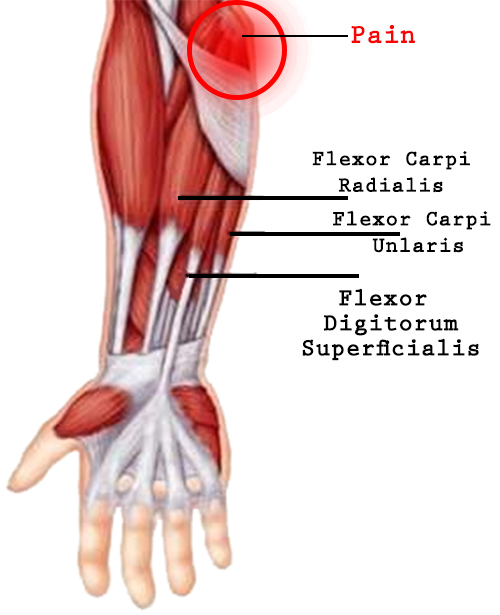
Golfer’s Elbow also known as “medial epicondylitis” is an inflammation of the tendons that originates from the medial elbow side. The pain sensation can be local or spread along the forearm till down the wrist. Indeed, Golfer’s Elbow is similar to a tennis elbow, which occurs on the lateral side of the elbow. Both these conditions are not limited to those who play golf or tennis but can affect anyone who does repetitive movement their for usually builds pain usually builds up with time and can get quite intense if the condition is not looked after. Therefore, rest, massage and specific exercises are well recommended. Golfer’s Elbow Symptoms Pain: The area of pain as described above is around the medial side of the elbow and can spread down the forearm to the wrist Stiffness: The area of inflammation controls the forearm flexors, indeed, making a fist or flexing the fingers/wrist can be difficult or painful. Even the elbow can feel stiff in movement. Weakness: Due to the pain, you may experience weakness in the affected arm/forearm Numbness or tingling: Along the medial side of the elbow, pass the Ulnar nerve, which can refer to the ring finger and pinky finger with numbness or tingling sensation. Risk factors for Golfer’s Elbow Here below is the risk factors list for Golfer’s Elbow: Age 40 or older Doing repetitive movement of wrist/elbow daily Obese If this post talks to you, book your next massage session now. Golfer’s Elbow Treatment Option The treatment options for Golfer’s Elbow are many. Along Melbourne Massage and Treatment Services, MLD can be the least invasive and recommended. The gentle touch and repetitive mechanical stimulation of the cutaneous nervous system can help reduce inflammation, stimulate relaxation, and reduce swellings in the area. Said so, as MLD can have several absolute and partial contraindications. This treatment can not be applied to all. So other services such as Myotherapy, Remedial Massage or Thai Massage are more recommended. The treatment would aim to work on the surrounding area of the inflamed tendon to improve the tone of the forearm flexors. Medications such as anti-inflammatories can also be considered for this condition, especially when rest is impossible due to work commitments. Therefore, you better talk to your GP about the medication option.
Muscle and Tendon are two types of fibres that connect bonds, allowing the joint to be moved by contracting or extending. Muscles and Tendons characteristics. A muscle consists of fibres of muscle cells covered by fascia, bundled with many more fibres, surrounded by thick protective tissue. So each muscle fibre is covered in the fascia, then wrapped as a whole muscle in more fascia. A tendon is a high-tensile-strength band of dense fibery connective tissue. Indeed tendons can transmit the mechanical forces of muscle to the skeletal system. Tendons, as per ligaments, are made of collagen fibres. Compared to a tendon, a muscle is elastic and sits in between 2 tendons parts which keep the muscle itself connected to bonds. So yes, muscles are not directly connected to bond themself. Luckily, there is to say, because if this was the case, it would be really easy to suffer from injuries like a muscle tear. Said so, it is now easy to understand that tendons are capable of holding more force. Injury type Due to the consistency of the tendon and its functionality, we can now understand why a tendon tear or rupture is a severe injury that requires surgical intervention and months of rehabilitation. On the other hand, often, after months of rehabilitation, still, the tendon would not go back to its original state. A common tendon rupture is Achille’s tendon. Achille’s tendon connects the lower part of the Gastrocnemius and Soleus to the foothill. Repetitive movement and repetitive partial load on this tendon are the leading cause of injury. Healthy muscle and tendon Simple and gentle exercises are a good way to keep your muscle and tendon out of trouble. The key points of these types of exercises are: Consistency Resisted load (by using rubber bands) Starting with light weight to then building up with time heavier load Good posture doing the exercises Have a day of rest from exercises once a week Avoid exercises that aggravate your pain. Said so, other critical points for muscle and tendons good health seating into: Having a good night’s rest Eating more fresh food than overprocessed food Regarding recovery from an injury, as previously mentioned in the ice pack and/or heat pack posts, the usage of temperature is recommended based on the stage of the injury and the pain experienced with it. Even though on an inflamed tendon, never apply a heat pack. Are you in need of treatment? Don’t look any further, and book your initial consultation by clicking here.
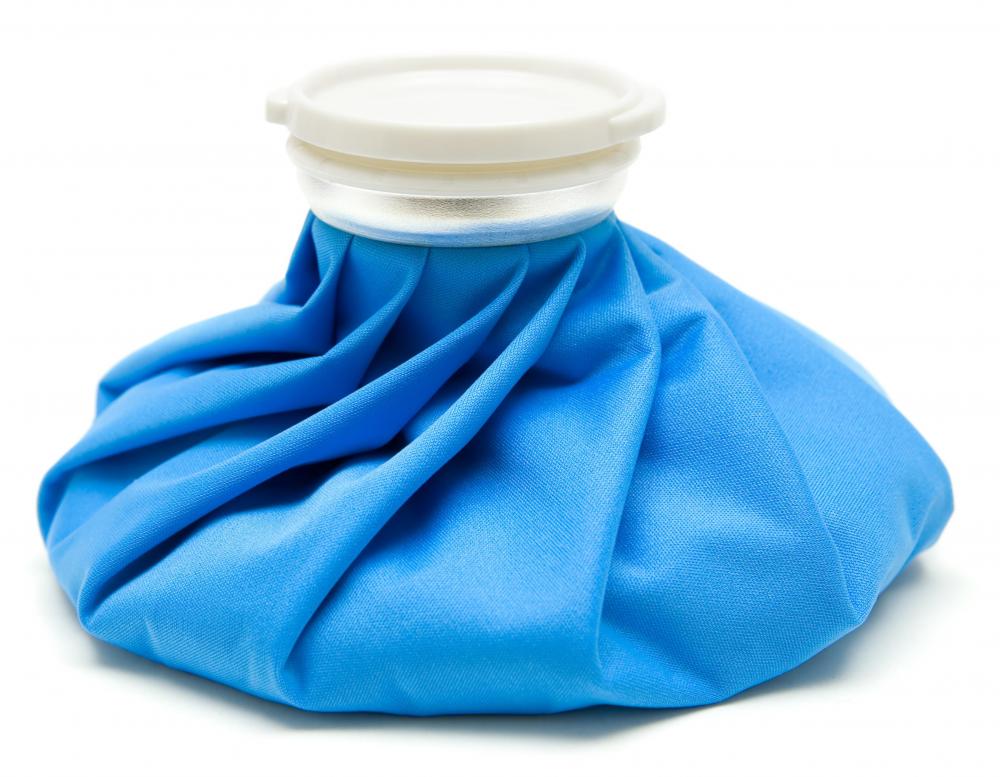
In a previous blog, we did talk about heat packs, now it is time to talk about the Ice Pack. Ice pack application, in the last few years, is a practice that got reviewed. What Ice Pack is about? An Ice pack, as the name says, is a cold (icy) bag. As better explained in this study an ice pack is something that can be applied to an acute injury, to prevent swelling and reduce pain, but it can’t be used for too long. As per the heat pack, an Ice Pack burn the skin, and that’s one reason why its usage has to be short (10 to 15mins at a time). In addition, extended exposure to icy temperatures, would reduce the blood flow around the injured tissue and can also damage nerves. Ice Pack usage recommendation: You have a new injury or aggravation of an existing condition, and the pain is above 7 out of 10. Where you want to minimize swelling to keep you mobile later. There are different types of Ice packs: Home-made one, ice from the freezer wrapped in a towel. Gel pack Ice Bag (as per the photo) Instant one – most of the time found in the first aid kit. Snap it and a chemical reaction would occur in the bag and freeze the bag. Those last ones are efficient as you can store them anywhere safely and use them as you need them. The cold lasts for about 20 minutes. Not to be used if they are broken. On the other hand, if you running out of ideas of what to use as a Cold pack, you can even use a bag of frozen food. Still would do the work. We have the ice bath and the cold show related to this topic. I did experience cold showers myself, most of the time not of my choice, but because of a limited supply of hot water, and I have to say that even on this topic, there are a series of debates on how that works and if it’s beneficial. So far, a cold shower, compared to a hot shower, is better for dry skin. This is because the heat of the water combined with soap can wash away the good oils of the skin. Then the benefit of an Ice bath can be more of a placebo effect. But again, I haven’t done much digging about myself, so I would stay out of any comment regarding it. Ice pack after a Massage? Well, as mentioned above, the usage of Ice Pack is suggested after an acute injury. So, either after a Remedial Massage or a Thai Massage, firstly there should be no acute injury, secondly, you want the blood flow along the worked area to stay active and not restricted. That’s why a heat pack would be more recommended. If you find this helpful information and need a massage, book your next session here.
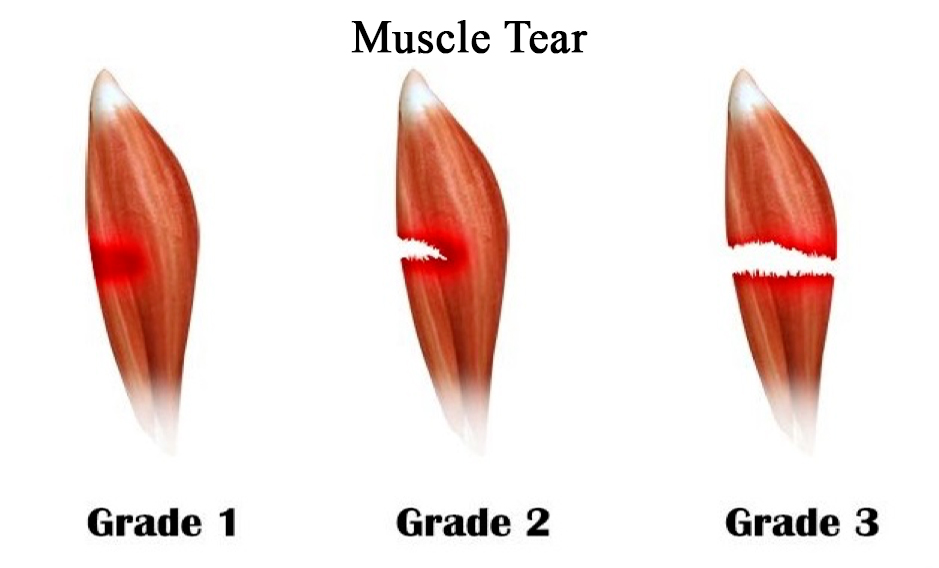
A muscle tear is an acute injury caused by a laceration of the muscle cells/fibres and or tendon to which the muscle is attached to. How can happen a muscle tear? A muscle tear happens when a muscle is weak and don’t activate at the right time. Weak muscles are common in repetitive movement or when a muscle overcompensates due to a fragile pattern. For example, tearing a hamstring is expected when the Gluteal Firing pattern is incorrect. This type of injury is common in sports activities. Still, it can also happen within a home environment by lifting a box incorrectly or during garden activities. The three grades of muscle tear. Grade 1 muscle tear is the mildest one. As per this case, only a few muscle cells have been torn. Symptoms are like: mild pain, moderate swelling, none or light bruising. In grade 2, a moderate amount of muscle cells have been damaged. Symptoms are like: Bruising is now more evident as per the swelling You must luckily hear a sound as the tear happens More severe pain, especially when trying to use that muscle. Grade 3 is the worst-case scenario. In grade 3 muscle tear, the muscle has fully torn. Still, a pop or a sound would happen as the tear happens. On the opposite side of where the muscle did lacerate, you will notice a bulge as the muscle coiled up after tearing. Weakness in using the limb where the muscle got torn. In case of a Grade 3 muscle tear, surgery is needed to reattach the muscle. How to treat a muscle tear? The immediate appliance of heat or cold packs is highly debated. A cold pack would numb the area and help with the pain symptoms. As mentioned in the “Ice Pack” blog post, that is actually recommended. On the other hand, a heat pack would help stimulate blood circulation in the affected area, reduce swelling, and boost recovery. It’s important to note that applying a heat pack too soon after an injury can actually make things worse. It’s best to wait until the acute phase has passed, which typically takes around 48 hours. At that point, heat therapy can be a helpful way to alleviate pain and promote healing. Regarding massage treatments, MLD can be the only technique used as soon as the tear happens. Indeed MLD would be highly recommended for boosting the recovery, especially in case of a tear in 3rd grade, where operation is needed. In case of a 3rd-grade muscle tear, the first thing to do is see a doctor. Other massage techniques, such as Myotherapy, Remedial Massage and Thai Massage, are still valuable for muscle tears. On the other hand, either Myotherapy, Remedial or Thai Massage can only be practised after 48 hours of rest are passed after the incidents. Indeed that 48 h is considered the acute phase of the muscle tear. How to prevent a muscle tear? More the body moves, the less the chance of injury. Making sure to do simple exercises involving basic body movement can help in muscle tear prevention. but not only. Keeping the joint moving is another essential aspect of injury prevention. How can massage help? Along with a massage treatment, the area of focus will be the torn muscle and surrounding area. Initially, the technique used with a massage treatment, especially for the injured area, would be MFTT and passive movement/mobilisation. That would help muscle recovery and facilitate joint mobility, reducing the muscle’s load. Going ahead with the treatments, techniques such as MET, a resisted muscle force technique, can be used. This would allow the muscle to gain elasticity. Book your next session by clicking here if you are suspicious of a muscle tear and need treatment.
In the previous post, we did look into plantar fasciitis and we only mention the Corrective Exercises for Plantar Fasciitis. Indeed, we did get to the conclusion that Myotherapy, Remedial Massage and Thai massage can help in reducing muscle tensions, for those muscles which take part in the foot’s unbalance, and that MLD can help in reducing the pain and reducing the inflammation within the plantar itself. What’s the role of the Corrective Exercises for Plantar Fasciitis? Exercises are a crucial step to take for a successful healing process. Corrective exercises for plantar fasciitis can be simply practised at home, without the aid of a personal trainer to follow you. In fact, corrective exercises are often simple movements, that require precision more than strength. Furthermore, is better to start slowly and gradually implement more difficult exercises and extra load. Indeed, the corrective exercises world is a step-by-step journey. If this post is talking to you, book your next massage session by clicking here. Corrective Exercises for Plantar Fasciitis: Foam rolling below the foot. Take a seat on a chair and start gently rolling the affected feet along on the foam roller. The bigger the foam roller, the gentler the exercises, due to lower pressure. If you have no foam roller, you can use a tennis ball too. The aim of these exercises is to gently self-massage the plantar of the feet and stimulates blood circulation within it. Plantar pressure with a towel. Always in a seated position, roll a towel on itself, and by holding it with both hands, put the towel under the foot. Start pulling the towel against the plantar of the feet Pull and hold for 15 to 30 secs about Drag the towel with the toes. Place a towel on the floor. The backside of the towel will be right below your toes Now gently, start grabbing the towel with your toes These exercises will reinforce the flexors muscles of the toes, in specific Flexor hallucis longus and Flexor digitorum longus, with the aim to improve the arch below the foot Single Calf Raise For this exercise, you will need a small stool or an Aerobic Step Kit Step with the front of the feet on the Areboic Step and start pushing up through the foot. For safety, you may wanna hold yourself to a wall with your hands You can start doing 1 foot at a time to increase the load. These exercises would create strength in the plantar flexor muscle of your foot. Along with the same muscles that do plantarflexion, there are the ones that do eversion and toes flexion too. In specific Perenous Longus, Perenous Brevis (eversion) and Flexor hallucis longus and Flexor digitorum longus (Toes flexion) If you suffer from plantar fasciitis because of an excess load of the body weight on the external side of the foot, these exercises would help you in recreating balance in the body load on the foot. Said so, those are some of the exercises that can be done. Few more are out there. If specific to your condition, you may want to do some exercises more than others. Most important is to have someone diagnose you with the specification of the condition and then suggest to you what exercises are the best. Plantar Fasciitis is a chronic condition, that with the right exercise and determination can be fixed. If you need help with it, don’t hesitate to book now your next session with Melbourne Massage and Treatment. And what about Orthotic Insole? The orthotic insole can be a quick-release type of approach for foot pain. On the other hand, orthotic insoles are most luckily the more common and misunderstood tool for foot pain. Yes, good to quickly reduce severe symptoms, but by itself is not going to fix the problem. Indeed, before spending hundreds of dollars on Orthodics, give a fair trial to exercises.
Plantar Fasciitis is a foot condition that can cause severe pain when walking or standing. Pain may be more intense in the morning when you step out of bed. If you ever had plantar fasciitis you will well know, that is not a fun thing to deal with. How to fix plantar fasciitis? In most cases, corrective exercises are the best way to retrain the foot and heal it once and for all from this condition. In this blog post, I talk more in detail about exercises for plantar fasciitis. How does Plantar Fasciitis manifest itself? Plantar Fasciitis manifest itself when the load of the foot is predominately put on the outside of the foot or on the back of the foot. It is the case we talk about an over-inverted foot, indeed a foot that is overloaded on its lateral portion. By doing so, the big toes flexor, the muscles that connect the big toes to the heel, get inflamed. As per consequence, pain does manifest below the heel. “It feels like if I got glass under my feet” someone that offers this condition would say. Plantar fasciitis demographic. People who spend a long time standing up/walking (waiters) Runners (who run with a heel strike) Pregnant women (due to the abundance of weight) The foot is a complex body part. Indeed, the foot contains 29 muscles, 26 bones and 30 joints. Therefore if not loaded correctly, the consequence can lead to major body musculoskeletal dysfunctions and unbalance. As already mentioned during the blog about the Fascia line, unbalanced feet can reproduce tension up to the back and shoulders. Plantar fasciitis functional test. A simple test that we do as massage therapists is to passively extend the big toes. (Windlass Test) If pain is reproduced on the heel, the test is positive. Therefore, this test tells us that the big toes, which most luckily would not even extend to their full range (65°), are not used when standing and or walking. That’s why is weak and tight. How can massage help reduce plantar fasciitis pain? At Melbourne Massage and Treatment, Myotherapy, Remedial Massage or Thai Massage can help reduce the tension along with the foot’s supinator muscles, which are responsible for over-invert the foot. That’s one of the reasons why the body weight gets overloaded on the lateral side of the foot. Regarding MLD, it can be most beneficial to reduce the inflammation within the plantar of the foot and help manage the pain. But as previously mentioned, massage can help in reducing the symptoms, and improve mobility. Where for full recovery, corrective exercises are essential. Was this post helpful? If you are suffering from Plantar Fascitis and would like to find a way out of the pain, book now your next appointment with Melbourne Thai Treatment. Here on the right side, is an example of a pair of shoes, for someone who suffers from plantar fasciitis. As you may notice, the lateral portion of the show is completely worn out, where the medial portion, is nearly touched, especially at the big toes area. So back to the fact, that the big toes are what should drive the foot along the strike motion if that shoe area is untouched, it means that person is not loading any weight on there. Footwear examination can be also used to identify weight balance in the foot area.
- 1
- 2