
If you have been at the clinic most recently, you may have heard me talk about LLLT (Low-Level Laser Therapy). LLLT is one of those tools that quietly adds a lot of value to any treatment modalities I get to offer, without making a big fuss, and without increasing the service fees. So yes, in this blog, we are going to look into why I use it, what the science says, and, most importantly, what it can do for you. First Things First: What Is Low-Level Laser Therapy? The simplest explanation I can share is that LLLT (also called photobiomodulation) uses specific wavelengths of light to stimulate your body at a cellular level. Indeed, LLLT is not a hot or burning type of laser, but it is a low-intensity, non-invasive light that interacts with your tissues to encourage healing and reduce pain. This is possible because LLLT stimulates the cell in producing more ATP energy (cell energy) which than can be used for the cell to replicate. Simply, it helps your body do what it’s already trying to do, just more efficiently. What Does the Science Say About Low-Level Laser Therapy? As a practitioner who offers his service based on scientific recommendations, I’m very particular about what I bring into the clinic. If it’s not backed by solid research, it doesn’t stay. Therefore, here’s what recent PubMed evidence tells us: Pain Reduction In a systematic review by Diaz et al. (2025), they looked at 44 randomised clinical trials and found that LLLT can reduce pain by 60–70% in certain musculoskeletal conditions (in this case, TMJ) while also improving function. When a systematic review shows such results, it is considered strong evidence. Supports Injury Recovery & Reduces Inflammation When looking at Lawrence J. Sorra K., (2024) review, that did focus on Low-Level Laser Therapy (LLLT) for Acute Tissue Injury or Sport Performance Recovery the highlighted facts about LLLT are: Modulate inflammation Improve tissue repair Support recovery after injury All with minimal risk or side effects. That said, in this review, it is also highlighted how, in acute injury, there is a lack of evidence for LLLT effectiveness. In conclusion, than, is shown how no side effects are present and how LLLT is a safe therapy to be add to other modalities, especially fitness classes. Works Best as an Add-On (Not a Replacement) About this last statement, that LLLT is not a substitute for other modalities, we have a meta-analysis by Awotidebe A. et al. (2019), which shows how LLLT can provide additional short-term pain relief when combined with exercise or therapy, even if it doesn’t always change long-term function on its own. And this is the key point most people miss. LLT is not magic; It’s a multiplier. Exercises are the medicine. Why I Use LLLT at Melbourne Massage and Treatment? I decided to invest in the usage of Low-Level Laser Therapy SymbyxBiome DuoCare 904, which operates in a wavelength range consistent with what research suggests is effective (typically around 800–900nm), as it can be an effective treatment modality to help my patient feel better, reduce their inflammation and pain, so that they can move better and be able to deliver exercises without bein in too much pain. And here is another important part: I don’t charge extra for it. Why? The answer is simpler than you may think. LLLT is not a “standalone service” in my philosophy; it’s a value-add. If it can: Reduce your pain faster Help your tissues recover better Improve your overall outcome Then, as with any other therapy, it belongs inside your session, not on top of your invoice. What LLLT Does Feel Like? When telling people what LLLT feels like, I respond with: “Drop your expectation”. In fact, you will feel: No heat No discomfort No downtime And yet, underneath the surface, your cells are being stimulated to: Produce more energy (ATP) Improve circulation Reduce inflammatory markers That’s where the real magic happens. It is a way to make your body do what it does normally, only faster. And there is no side effect. What Condition Can Benefit Best From LLLT? Conditions where LLLT is recommended for are: Persistent muscle pain Tendinopathies Jaw pain (TMJ) Post-injury recovery Fibrosis Scar tissue Any presentation would need treatment that lasts 10 to 20 minutes, and the frequency of treatment can be 2 to 5 times a week, with results of pain relief after 3 to 6 weeks. Those numbers vary depending on the type and location of the injury. What we know is that for the early stage, it is better to have more frequent treatment, and after week 1, the treatment can drop from 4 to 5 times a week to 3 times a week, till once a week for major injury if the treatment has to go on for 5 to 6 weeks. Why Frequency Matters As mentioned above, LLLT works by stimulating your cells, particularly the mitochondria, to produce more energy (ATP), which helps with: Tissue repair Reducing inflammation Pain modulation But that effect doesn’t last forever; cells need a more frequent stimulation to obtain the best results. Therefore, if sessions are too far apart, you lose momentum, but if they’re too close without reason, you’re not adding extra benefit. So that’s why, in the initial phase of an injury, we work more often to boost the recovery, and once the recovery is nearly optimal, and you are doing your exercises and structural strength, then the LLLT session can be placed further apart. What Is The Bottom Line Regarding Low-Level Laser Therapy? After so many years in the massage industry, and after all the research and studies of different modalities, there is one thing that I have learned. There’s no single “miracle treatment.” But, on the other hand, there are combinations that work extremely well together. Hands-on therapy + movement + the right adjunct tools, that’s where results happen. And LLLT is one of those tools. So drop your expectation of magic and no effort […]
Monthly Archives: April 2026

Blog
Low Level Laser Therapy in Melbourne: Does It Actually Work?
If you have been at the clinic most recently, you may have heard me talk [...]
Continue reading 09
Apr
Apr
Blog
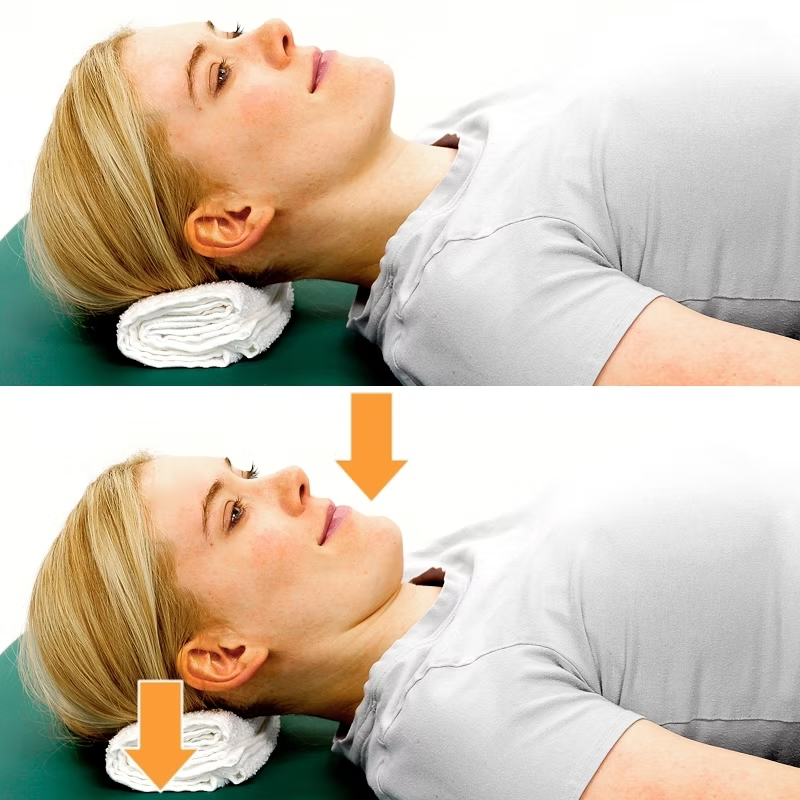
Your Neck Matters! 3 Neck Strengthening Exercises To Stop The Pain
Neck pain is such a common presentation, and often I have to hear from my [...]
Continue reading 30
Mar
Mar
Blog
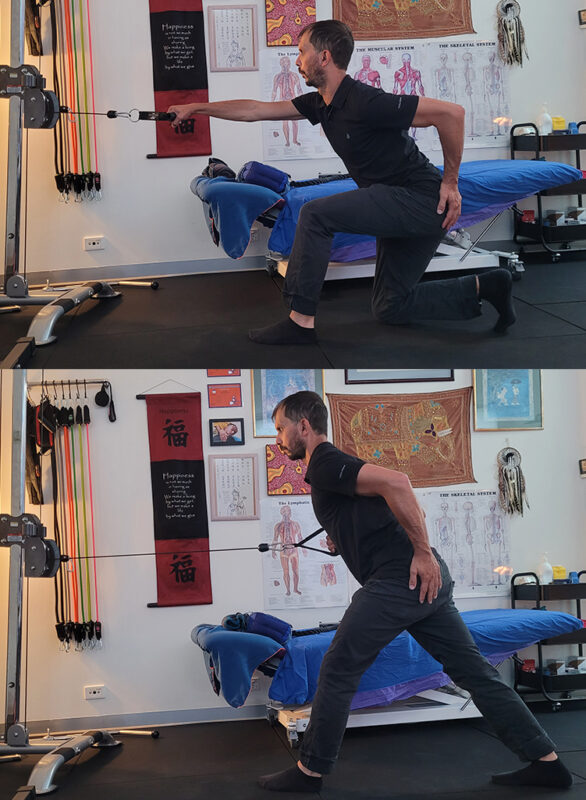
There Is No “Perfect” Lunge. Let’s Find Out Why.
While I guide my client during a 1:1 fitness class at Melbourne Massage and Treatment, [...]
Continue reading 23
Mar
Mar

Blog
Why the Gluteus Medius Is Essential for Balance, Longevity and Fall Prevention
One thing that can really create terror while we age is falling. No matter the [...]
Continue reading 16
Mar
Mar
Blog
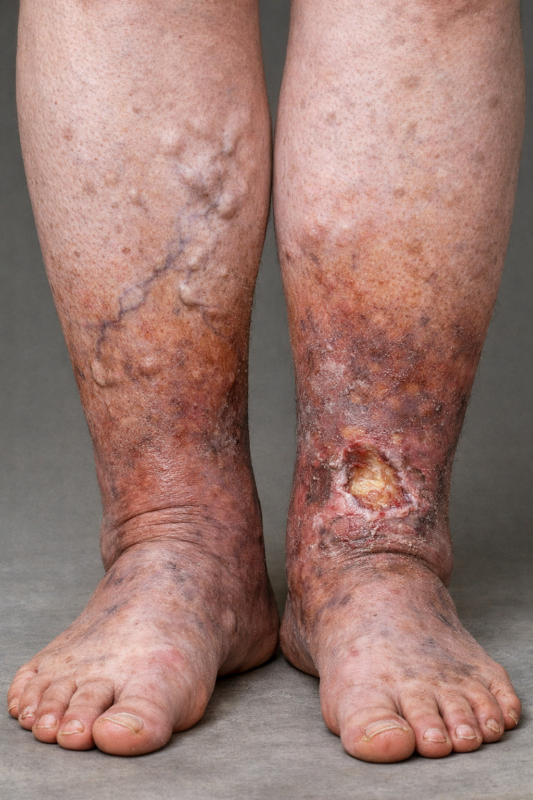
Chronic Venous Insufficiency and Swollen Legs: Compression Is The Way To Go
In Australia, Chronic Venous Insufficiency (CVI) affect more women than men, with a ratio of [...]
Continue reading 09
Mar
Mar