
What is Fascia?
Why is it so important?
How does it work? How can Thai Massage help improve fascia mobility?
A fascia (from Latin: “band”) is a band or sheet of connective tissue, mainly made of collagen, that sits below the skin and attaches to, stabilises, encloses, and separates muscles and other internal organs.
Firstly, fascia can be classified by layers: superficial, deep, visceral, or parietal or by its function and anatomical location.
Like other body parts, such as ligaments, aponeurosis, and tendons, fascia is made from fibrous connective tissue.
In addition, these connective tissues contain bundles of collagen fibres oriented in webby patterns, parallel to the direction of pull.
About collagen fibres, they are produced by fibroblasts, contained within the fascia.
In conclusion, fascia differs from other body components such as ligaments and tendons.This is because ligaments hold bones together, and the tendons attach the muscles to the bones.
Going ahead we can define F. based on its location and
| Superficial F. | This is found just below the last skin layer, the subcutis, in most regions of the body, blending with the reticular layer of the dermis. |
| Muscular F. | Defined as the fibrous layer surrounding the muscle, or other body parts such as nerves, bones. |
| Visceral or parietal F. | This type of structure suspends the organs with their cavities and wraps them in layers of connective tissue membranes. |
In regard to the functionality of the F., we look into the ability of this tissue to allow the muscle to move freely.
If this post is talking to you and you are in need of a massage, book your next session by clicking here.
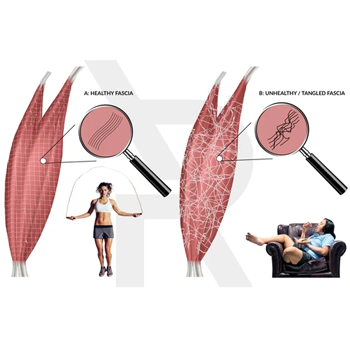
So let’s imagine this really thick web, sitting between the skin and the muscle and around the muscle too.
If the web is overconnected, that means it is tight, and the muscle would find it difficult to move and slide.
The same would happen for tendons and organs that need to function by being able to move freely.
For example, it does often happen to see customers that when asked to flex the shoulder, as they bring the arm over the head, past the 90° point, there is noticeable dragging in the fascia along the anterior and/or posterior and/or lateral thoracic area.
The person, unless told to feel what happens in the thoracic area, would hardly be aware of any restrictions in the thoracic area.
Having said that, we can now open a Pandora’s box and talk about the fascia lines.

Fascia lines connect the body side to side in the long, for the horizontal and diagonal directions.
As per the example, we have an F line that travels from the foot to the head.
Indeed, this F line starts from the Fibularis M, going up for the IT Band, into the TFL, Obliquos Abdominal muscles, opposite Serratus Anterior, Rhomboids, and finally to Splenius Capitis.As a result, someone who suffers from flat feet, and so has Fibularis M, under constant pulling force, may experience shoulder pain on the same side of the body because of Fascia restrictions.
But there are more F. lines than the diagonal ones.
In fact, we got a Superficial F. line, Functional F. line and Lateral Lines.
So, lastly, how can Thai Massage help?
Thai Massage can help with stretching the fascia by applying a force on the skin in the direction of the restriction.
It is enough to check in which direction the skin feels tight, and that’s the direction in which we want to apply a stroke with a pulling force, strong enough that the client does actually feel a stretch.
At Melbourne Massage and Treatment, I use techniques of work like MFTT and/or Cupping and static/dynamic stretching.
In regard to cupping, add MFTT, which is a technique of work that I did learn at RMIT along with my studies for the Diploma in Remedial Massage.
The static/dynamic stretch, indeed, is part of the techniques used along with the Thai Massage.
In conclusion to this blog post, I would like to invite you to see this video from Dr Gil Hedley, which dives into the magnificence of Fascia.
Giovanni La Rocca
Giovanni moved to Melbourne, Australia, from Italy in 2008 and became a citizen in 2017. He started studying massage therapy in 2016, then completed a Bachelor of Health Science in Clinical Myotherapy in August 2024. During those years, he also specialised in Thai Massage and Manual Lymphatic Drainage for presentations like Lipoedema and Lymphoedema and recovery from Cosmetic Surgery. Nowadays, he runs his clinic in Coburg, Melbourne, where he integrates movement therapy into his practice to enhance overall well-being. He also values meditation, having completed several Vipassana courses. Committed to continuous learning, he aims to share his expertise in integrated therapies to help others achieve balance and resilience.