
ACL stands for anterior cruciate ligament, and is the strongest ligament in the knee. ACL injuries can be time-consuming, depending on the severity. At Melbourne Massage and Treatment in Fitzroy North, I offer an ACL rehab program that aims to help you recover based on your clinical history, daily activities, including your sports, if any, and consider that the healing time can’t be boosted, but assisted.
ACL – What It Is?
ACL is the strongest ligament in your knee, and connects the femur to the tibia.
Its role is to keep the knee stable, especially during activities that involve sudden stops, changes in direction, or jumping. You can then understand why so many athletes or sports lovers end up with an ACL-type injury. As with all ligaments in our body, the ACL doesn’t have an excellent blood supply, which makes its recovery longer, compared to what can be a muscle injury.
What is Myotherapy and How Can It Help with ACL Rehab?
Myotherapy is a hands-on treatment method that targets muscular pain, improves joint mobility, and addresses the root causes of musculoskeletal injuries. For ACL rehab, this approach is essential because an ACL injury affects not just the knee but the surrounding muscles, joints and movement patterns.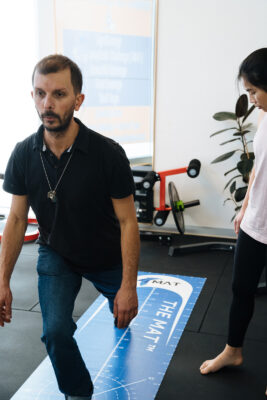
Hands-on treatment can indeed be a good start for rehab and injury, as it not only creates a trust between the patient and the therapist, but can help in creating better awareness of the muscles, which in a second phase of the myotherapy appointment are going to be used for delivering tailored and injury-specific exercises.
The goal is to support your ACL recovery and knee rehabilitation holistically.
ACL Injury: Scan and Manual Test
There are several methods of diagnosing an ACL injury.
Scans:
- Arthroscopy – A keyhole surgery, where a camera is inserted in the knee to check the level of injury. Partial or complete ACL tear.
- Magnetic Resonance Imaging (MRI) – Less invasive than an Arthroscopy, but still expensive to run. Indeed, it is rare nowadays; in Australia, you can get an MRI prescribed for this presentation. More information is available here.
Manual Test
Those together with an attemptive clinical history, range of motion and functional test would help to tailor a conclusion on a possible ACL injury.
ACL and Surgery – Is Surgery Still a Thing?
Surgery techniques and technologies have come a long way from what we could expect, and yes, ACL surgery is still a thing.
That said, before going for surgery, you will be asked to try and recover from your injury with conservative treatment, like a rehab program.
The reason behind this is:
- Suregey cost and pressure on the public health system
- Rehab gives as good results as surgery most of the time
- Surgery also goes by the severity of your injury – is any other knee tissue/structure injured, or is it only the ACL?
- Post surgery, you still have to go for rehab, and it would still take 6 to 12 months for a full recovery.
- Athletes may benefit the most from ACL surgery, given its longer-lasting effects on knee stability.
More information about ACL rehab vs ACL surgery is available from the
The ACL Rehab Phases: Strengthen Beyond the Knee
To recover from an ACL injury, we need to look behind the mechanics of your lower limb, and set a starting and and ending point of recovery.
Acute Phase
In the acute phase, which is the first one to two weeks after injury, we may focus on isometric holds, gentle movement, and spend more time on hands-on treatment. In this phase, the aids of crutches is mandatory.
Strength Phase
Past the acute phase of the injury, you will notice how it would be easier to engage the knee joint, as the swelling would be eased, and therefore, you can achieve greater movement. There, we will start incorporating eccentric and concentric loads, with some light-weight or light-resistance bends. This phase can last somewhere between 10 and 12 weeks.
All of these would be a step-by-step process. So the loads would be progressed weekly, based on the strength and mobility outcome. Sometimes, you will have to push through some mild pain, but the most important thing is that you keep that joint moving, and have good rest, good food too, to enhance the recovery at its best.
Return to daily activity – RDA
In the final stage, the focus would shift to plyometrics, an essential part of ligament rehab. That’s where we would re-train your knee to act pre-injury time. This can take another 12 to 24 weeks. It all depends on the severity of the injury and what your needs, in terms of sport or daily activities, are.
So, the combination of myotherapy treatment with targeted rehabilitation exercises and fitness classes for recovery is what makes Melbourne Massage and Treatment service stand out.
In my rehab-focused classes, we work on:
Strengthening the muscles that support the ACL
Improving balance and stability to prevent re-injury
Gradual conditioning to safely return to sports, running, or everyday activities
My Personal Approach
At Melbourne Massage and Treatment, I work one-on-one with each client.
I assess your movement, identify areas of weakness or tension, and design a personalised ACL rehab program. To be even more specific to your individual presentation, I do use THE MAT as an aid. A measurement tool that allows me to test your mobility and stability, giving us objective numbers and data to work on, too.
Recovery from an ACL injury takes time, but with the right approach, you can regain full function and return to the activities you love. I’m here to guide you through every step of your ACL rehabilitation journey.
If you’re ready to start your ACL rehabilitation in Fitzroy North or want to see how myotherapy can help, book a session with me at Melbourne Massage and Treatment today. Let’s get you moving stronger and safer than before.
FAQs – ACL Rehab
Giovanni La Rocca
Giovanni moved to Melbourne, Australia, from Italy in 2008 and became a citizen in 2017. He started studying massage therapy in 2016, then completed a Bachelor of Health Science in Clinical Myotherapy in August 2024. During those years, he also specialised in Thai Massage and Manual Lymphatic Drainage for presentations like Lipoedema and Lymphoedema. Nowadays, he runs his clinic in Fitzroy North, Melbourne, where he integrates movement therapy into his practice to enhance overall well-being. He also values meditation, having completed several Vipassana courses. Committed to continuous learning, he aims to share his expertise in integrated therapies to help others achieve balance and resilience.