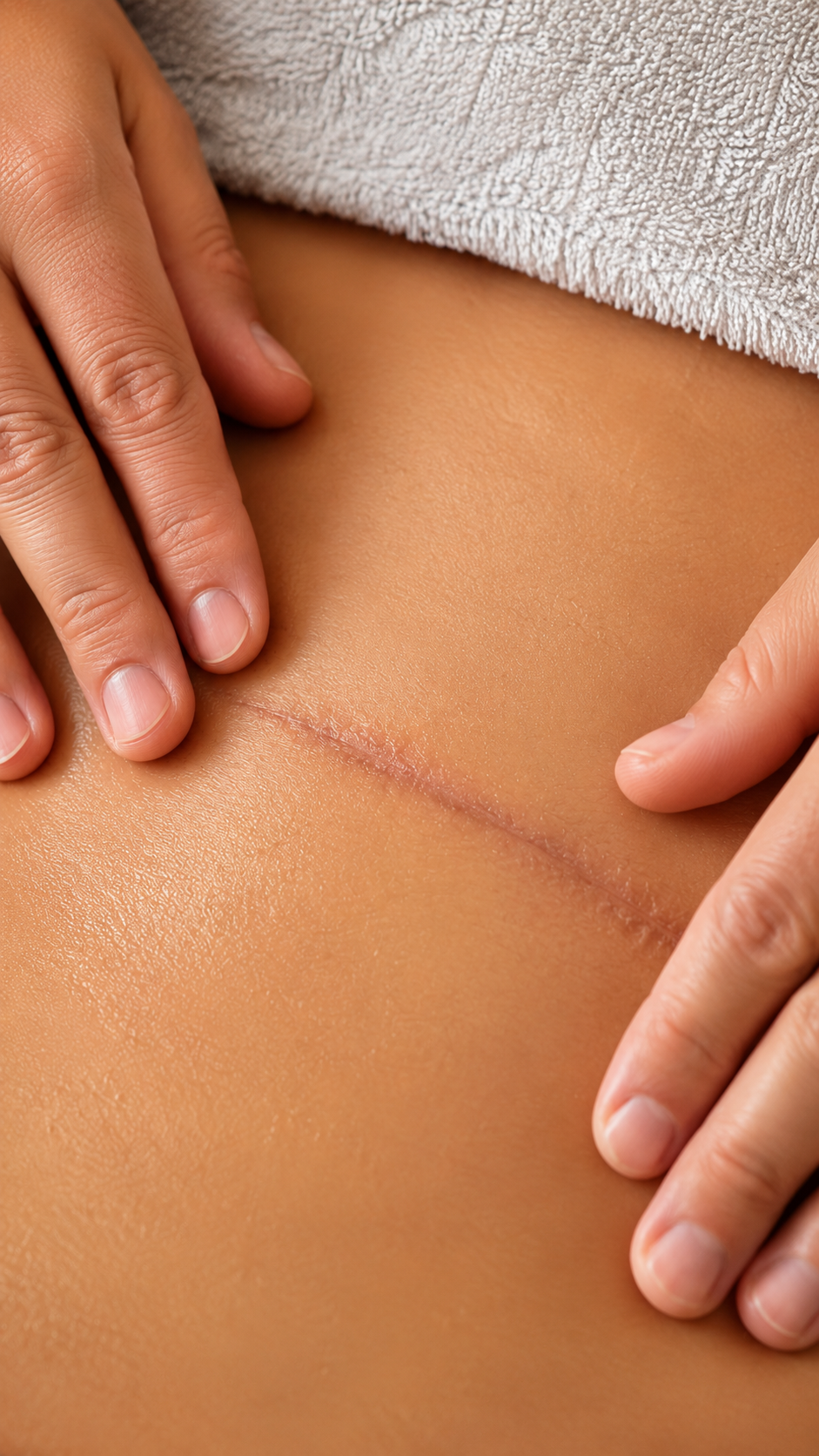
The Psoas Muscle. The Psoas muscle is a muscle that seats in the Lumbar region of the body. It is palpable through the abdominal region when the client is in the supine position. Psoas Muscle is often related to and taken into consideration with iliacus muscle, as those 2 muscles share the insertion tendon and point. For this reason, they get called Iliopsoas Muscle. Origin, Insertion, and Action of the Psoas Muscle: Origin: Body and Transverse process of the Lumbar Vertebrae (L1-L5) Insertion: Lesser Trochanter of the Femur Action: with the Origin fixed: flex the hip externally rotate the hip with the Insertion fixed: flex the trunk towards the tight tilt the pelvis anteriorly flex the vertebral column laterally. Innervation is supplied from the anterior rami of spinal nerve L1-L3 Blood Supply from the lumbar branch of the iliolumbar artery The Psoas muscle has a reference pattern that involved the abdominal area but even the front of the tight. It is often tight for people who spend a lot of time seating on a chair, like office workers and or who drive for long hours. This happens because the muscle is in constant contraction when we spend time seating. On the other hand, the Psoas Muscle is often also related to emotional distress. This can happen because when we live with negative emotions we tend to contract the abdominal area and tight the muscle-up, especially for reaching out a fetal position, which recalls maternity safety. By analyzing the action of this muscle, it is easy to notice how is involved in assuming a fetal position, as it is a hip flexor. In fact, it contracts the 2 limbs, the upper and lower to gain one with each other. Treating the Psoas Muscle directly is not always recommended as direct work unless the person has been going through a series of treatments already. This is because where the muscle is lying it is a sensitive spot to access and as it holds a lot of tension, can be a bit sensitive to the touch. In need of a massage? Book now your next appointment, at Melbourne Massage and Treatment clinic. To treat the Psoas Muscle the client is lying in a supine position. Firstly we identify the muscle. For doing so after the client did lie in the supine position, the therapist will place her/his hands off the rectus abdominis, on its lat. border, and will create resistance on the client’s tight as it goes for active flexion. With the hand seating next to the rectus abdominal area, the therapist can feel the muscle activating. Once the Psoas has been isolated, the therapist can place both hands or one on the muscle, asking the client to breath-in deeply as is flexing the knee (foot running along the table) and as the client’s breath out (it is important here following the breathing wave) the therapist can apply a force straight down. Furthermore, to ensure that we can release tension from the Psoas Muscle, we have to work on the muscle surrounding it, like the other muscle that holds the same Origin/Insertion patterns, like: Erectus Spinae group, Quadratus Lumborum, Quods Hamstring In fact, the psoas muscle can be involved in presentations such as lower cross syndrome (LCS). Are you struggling with pain and or body ache? Book now your next massage appointment, at Fitzroy North clinic. Often as therapists, we would work on the surrounding muscle before doing direct work on the Psoas. This is because direct work in such a sensitive area can be too intense to start with and could make the client feel vulnerable or uncomfortable. A good exercise to keep the Psoas muscle in shape is a daily walk, even though for a nice and balanced walk we want to make sure to have a correct Extension Leg Firing Pattern.
Tag Archives: Fitzroy North
Exercises for Upper Cross Syndrome As previously mentioned, the UCS is caused by a constant habit of poor posture, to achieve a correct posture on top of massage therapy, we would need to do exercises for Upper cross syndrome. So, there are 2 main groups of muscle that we want to target. 1st group, the tense muscles: Levator Scapulae Upper Trapezius Pectoralis Major Second group, weak muscle Deeper Neck Flexors Rhomboids Middle Trapezius. Now, let’s go through some exercises for Upper cross syndrome. Brugger exercises for Neck deep flexors. This exercise is going to focus on improving the strength of the deep flexors. Stand straight with feet apart ; Place 2 fingers, one on each sternocleidomastoid and start gently and slowly flexing the head forward. The fingers seating on the Sternocleidomastoid (SCM) would allow you to keep those muscles deactivate and so would place all the strength of flexion on the deeper muscle that we are trying to train in gaining strength. If you are not sure where the SCM is, place a hand horizontally between the neck and the upper chest, along the Clavicle line. Rotate your head gently right and left and those 2 muscles that pop up below your hand when you rotate the head are the SCM. Just be aware that the L SCM will activate when you rotate right and vice versa; 3 repetitions for 10 head flexion. Do you feel like you need help with your neck pain? Book now your next appointment at Fitzroy North Clinic. Strengthening the Rhomboids and Middle Trapezius. For this exercise, we would need an elastic rubber band for exercises. · Stand straight, feet apart, and wrap the elastic band on your fist, thumb facing out. · As you breathe in flex the elbow at 90, breathe in and bring the rubber band in tension. As you breathe out extend the elbow out. · Release and start again. 3 repetitions of 10. All those exercises have to be done daily for 6 weeks in order to be effective to change the UCS. Self Massage for Pectoralis/Upper Trap/Levator Scapulae. Pectoralis Self Massage exercises: Lie down in a prone position with the arms along the body; Place a tennis or a spiky ball right between the Pectoralis and the floor; Keep the foot’s toes anchored on the floor; Gently push yourself forward and back by breathing in (from the nose) and out (from the mouth). If you would like more pressure, is enough to open the arm at 90 and lightly extend the arm, by lifting the hand from the floor. Upper Trap and Levator Scapulae Thai Yoga exercises: Start by lying in a supine position and the ball will be seated between the shoulder and the floor. Place the ball right next to the upper angle of the scapula. This time keep your shoulder flexed at 90 degrees, so with the hand facing the ceiling. Start gently a slow rotation movement at the shoulder, by drawing a circle with the hand. 3 series of 6 repetitions for each rotation movement. With Thai Yoga, you wanna make sure that each exercise is done slowly and gently. Those exercises often work on the delicate area of the body and can reproduce massage pain. Moving the body slowly and gently and having constant breathing in and out would allow you to live Thai Yoga at its full potential.
What is, Upper Cross Syndrome? Upper cross syndrome (UCS) is a common posture imbalance that affects many people nowadays and it is caused by repetitive poor posture habits. The body‘s muscles work in coordination with another one to keep our posture erected along the Plumb Line. The Plumb line is an imaginary line that runs from the top of the body down to the foot, passing by the: Mastoid process of the skull Middle Acromion (shoulder joint) Centre of gravity of the body (pelvis) Greater Trochanter (GT or Head of the Femur) Side of the Knee Down to the Malleolus. The head and shoulders are protracted compared to the plumb line, for someone that suffers from UCS. This happens when there is an unbalance between the anterior and posterior portions of the cervical area. So, to better understand what UCS is, let’s go through which muscles are involved in this condition, and the muscle’s role. Let’s start by drawing a diagonal line from the shoulders down to the upper chest area of the pectoralis (). The diagonal line would cross first the Upper Trap (UT) and Levator Scapulae (LS) for then cross the Pectoralis Major (PM). What do these muscles have in common? Tightness. The tight pectoralis would protract the shoulders. On the other hand, UT and LS would elevate the shoulders and scapula and accentuate the shoulder protraction. Indeed, this force applied bilaterally would place the muscle that is attached from the spine into the Scapula (or Shoulder Blade) under constant stretch, as for the muscle that keeps the neck erect, like the Deep Flexor Muscles (Longus Colli, Longus Capitus, Rectus Capitus and Longus Cervicus). Do you feel like you need help with your neck pain? Book now your next appointment, at Fitzroy North clinic. Now let’s draw a second diagonal line, in the opposite direction of the first one . This line would start from the anterior side of the body. From the neck area and go towards the posterior inferior side of the body. Therefore, would cross first the Deeper Flexor Muscles of the neck and then the Rhomboids (RH) and Middle Trap (MT). What this muscle got in common? As mentioned before because those muscles are placed under constant stress, they get weak, and can’t hold the neck and the scapula in place. How massage therapy can help? Massage therapy is a great way to create balance in the body structure. So, along with a massage session, either Thai Massage, Remedial Massage and or Myotherapy, we would start by doing a series of postural assessments and Range of Motion (ROM). This would allow me, the therapist, to pint point out what muscle needs more attention, and if there is more presentation to add to the UCS. From there then, we may start working on releasing tension from the Pec area and the UT, using gentle strokes that involve stimulating blood flow and heat in the area. Where per areas like rhomboids we would use techniques that may recreate some pain, so to stimulate the muscle to be activated. Said so, depending on the massage therapy I am offering, the approach can be slightly different. In conclusion, there is to say, that massage therapy by itself, would not be enough, if the person, at the end of the treatment, would go back to their routine life. It would be important that the patient follows the exercises that they would give at the end of the massage session. Exercises for UCS


