Knee pain is a common form of injury and can affect people of all ages and activity levels. Common mechanisms of action that lead to knee pain include an intense increase in load training, repetitive activities, osteoarthritis, a sudden change in direction during a sport activity, muscle or tendon tears, ligament injury or irritation around the kneecap.
If you are experiencing knee pain in Coburg, the first step is understanding what may be contributing to your symptoms rather than simply treating the painful area.
At Melbourne Massage and Treatment in Coburg, I use a combination of clinical assessment, hands-on treatment and exercise to help manage knee pain. Depending on your presentation, this may include Remedial Massage, Myotherapy and a progressive exercise program.
What can cause knee pain?
“Knee pain” is a symptom, not a diagnosis. As with any joint pain presentation, first things first, we want to rule out whether what we are looking at is a joint pain presentation or a muscle-related injury type of pain.
To do so, we need an extensive understanding of the mechanism of injury, like how/when the pain started and how/when the pain increases or decreases.
That information can start giving us some clues about what type of injury we may rule in or rule out
Here is a list of common areas or presentations to which knee pain can refer to:
- Pain around or behind the kneecap
- Patellofemoral pain
- Knee osteoarthritis
- Patellar tendon pain
- Quadriceps or hamstring-related problems
- Pain following an increase in running, walking or gym training
- Knee pain following an injury
- Pain associated with changes in lower-limb strength or movement
- Stiffness and reduced knee function
To give you a better understanding of how each area of the knee can correspond to a specific injury, let’s look at patellofemoral pain, which commonly becomes more noticeable during activities that load the knee, including squatting, stairs, running, jumping or prolonged sitting.
But your pain, perhaps, could also be from an ACL injury, and it may present at the anterior portion of the knee, and this is why I don’t use a one-size-fits-all approach to knee pain. Unless we can pinpoint why you are in pain and what structure is responsible for it, going for a random treatment plan would not help.
Knee pain assessment in Coburg
During a Myotherapy appointment, I look at more than just the painful spot.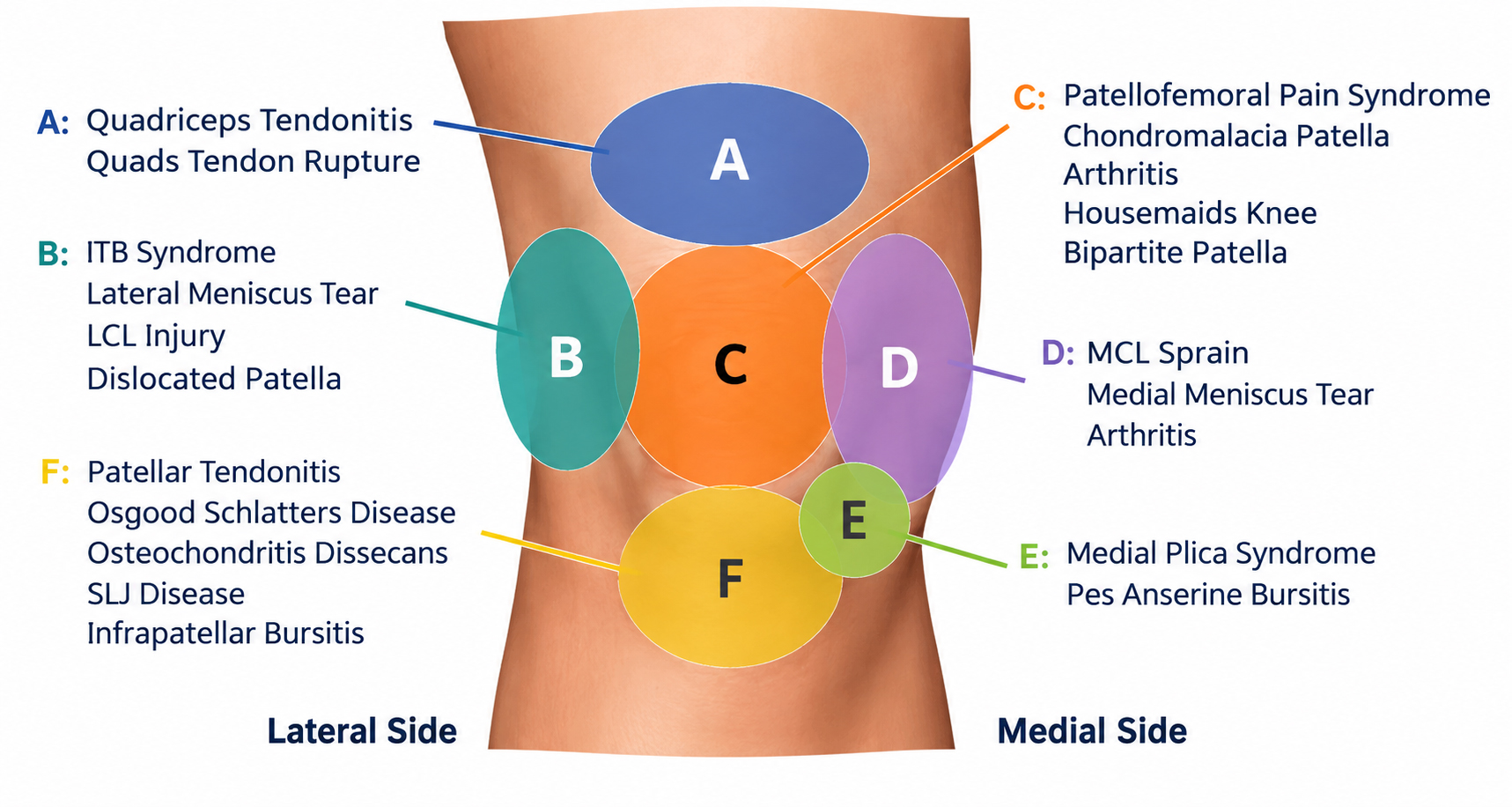
The assessment can include your symptoms, medical history, previous injuries, training or work demands and the movements that reproduce your pain.
Other things we may look at include:
- Knee range of motion
- Hip and ankle movement
- Quadriceps and hamstring function
- Hip strength
- Single-leg movements
- Squatting and stepping movements
- Running or other sport-specific activities
- How your symptoms respond to different loads
Along with that information collection and movement pattern, I will ask you to go for, we can better understand what the structure that gives you pain is: a meniscus or a ligament, as per a quad tendon or a hamstring tendon.
The purpose of this assessment is not simply to find something that looks “out of alignment”. It is to understand what may be contributing to your symptoms and determine what can be changed.
How can Remedial Massage help with knee pain?
Remedial Massage is an ideal hands-on treatment to reduce pain and stress on muscles that surround the knee joint, which may be contributing to your symptoms.
Then, based on your individual presentation, treatment may include work around the quadriceps, hamstrings, calf muscles, gluteal muscles and other relevant areas of the lower limb.
What is important to notice, on the other hand, is that massage does not directly “fix” every cause of knee pain, and it should not be considered a replacement for rehabilitation when exercise is required.
Research on massage therapy for knee osteoarthritis suggests that massage may provide short-term improvements in pain, stiffness and function, although the evidence is limited and the longer-term effects are less clear. [2]
This is why I see Remedial Massage as one part of a broader treatment plan when appropriate.
Myotherapy for knee pain
Among the services that I do offer here at my Coburg clinic, Myotherapy takes a broader clinical approach to musculoskeletal pain.
Rather than simply massaging the knee or surrounding muscles, treatment can combine:
Assessment → hands-on treatment → movement → exercise → gradual loading`
The exact approach depends on your symptoms and goals.
Hands-on treatment may be used to help manage pain, muscle sensitivity or movement restrictions. Exercise can then be introduced or progressed according to what you need to return to.
For someone who has knee pain when squatting, for example, the goal may not be to avoid squatting forever. Instead, we can look at how much load you currently tolerate and gradually build your capacity.
For someone who has knee pain when running, the approach may involve modifying training temporarily while building strength and tolerance before progressively returning to running.
Exercise is an important part of knee pain management
Exercise is one of the most important components of managing many types of knee pain, and probably any form of pain.
From research to clinical experience, I support exercise therapy for knee osteoarthritis and any form of knee pain with different types of load and forms of exercise, including resistance training, cycling and other exercise approaches showing benefits for pain and function. [4]
Why exercise is the way to go is because we want you to be functional and capable of loading your knee with as little trouble as possible. So, by increasing the load gradually and exposing your knee joint to positive stress as a controlled load, it works in favour of our long-term goal: you being pain-free.
And of course, based on your presentation, we may need to change the type of exercises, especially in the early stage, when the inflammation is still acute, the level of sensitivity is still high, and the structure it may not be ready for any random load.
Therefore, the important point is that exercise needs to be appropriate for your individual presentation.
What might a knee exercise program look like?
As already mentioned above, there is no single “best knee exercise” that works for everyone.
A program may start with relatively simple exercises and progress as your symptoms and strength improve.
Stage 1 – Movement and tolerance
The first stage may focus on movements that you can perform comfortably and consistently.
Examples can include:
- Controlled knee bends
- Sit-to-stand exercises
- Supported squats
- Step-ups
- Gentle knee extension exercises
- Calf raises
- Hip strengthening exercises
The aim is to establish movement and load tolerance without unnecessarily aggravating your symptoms.
Stage 2 – Strength
Once basic movements are tolerated, exercises can become progressively more challenging.
Depending on your needs, this could include:
- Squats
- Split squats
- Lunges
- Step-ups and step-downs
- Romanian deadlifts
- Leg press
- Knee extension
- Hamstring exercises
- Calf strengthening
- Hip abductor and hip extension exercises
And not all those exercises have to be done all at once. Our focus would be on what equipment you have access to, and what exercises are easier for you given your clinical history, time, and injury.
Stage 3 – Functional loading
Based on your goal, we focus on what the functional load is going to be: sport, running, work or gym training; the exercises need to become more specific to your requirements.
This might include:
- Deeper squats
- Loaded lunges
- Single-leg exercises
- Faster step-downs
- Jumping and landing
- Running drills
- Change-of-direction exercises
- Progressive resistance training
The objective is not simply to make the knee stronger in isolation. It is to improve your ability to tolerate the activities you actually want to perform. That’s where plyometrics come in, based on your needs.
Should you stop exercising if your knee hurts?
As with any form of pain and injuries, complete rest is good for a short period of time.
Indeed, knee pain does not always mean that you need complete rest.
In many situations, completely stopping activity can reduce your physical capacity without addressing the factors that contributed to the problem in the first place.
Instead, it may be appropriate to temporarily modify the intensity, volume, range of movement or frequency of an activity and then gradually rebuild your tolerance.
What we want to achieve with exercises, therefore, is not a pain-free load, but a low level of pain response. This tells us that we are still stimulating your structure (knee) and nervous system to respond to the stimulus, without placing the knee joint itself or the surrounding muscle or tissue in any form of intense danger.
So yes, the appropriate amount of exercise depends on the individual, the condition and the irritability of the symptoms.
This is why an exercise program should be adjusted according to your response rather than following a generic program from the internet.
Remedial Massage and exercise: why combine them?
Hands-on treatment and exercise do not have to compete with each other.
They are part of a unique treatment plan.
Remedial Massage may help with short-term pain, muscle soreness or soft-tissue sensitivity, while exercise provides an opportunity to progressively improve movement and load tolerance.
For example, someone with knee pain may initially benefit from hands-on treatment to help manage symptoms while also beginning a simple strengthening program.
As their tolerance improves, the exercise program can become more demanding.
This approach reflects how I work at Melbourne Massage and Treatment in Coburg: hands-on treatment can be useful, but massage alone is not always enough.
How I approach knee pain at my Coburg clinic
So, to summarise, my approach is based on your symptoms, history, current physical capacity and goals.
Depending on your presentation, your treatment may include:
1. Clinical assessment
Understanding your symptoms, history, activities and movement.
2. Hands-on treatment
Remedial Massage or Myotherapy techniques may be used where appropriate.
3. Exercise
Exercises are selected according to your current capacity rather than simply giving you a generic knee routine.
4. Progressive loading
As your tolerance improves, exercises can become more challenging.
5. Return to activity
The ultimate goal is to help you return to the activities that matter to you—whether that is walking, running, working, exercising, playing sport or simply moving more comfortably.
Knee Pain and Scan
A scan can be and X-ray if we are looking at the bone, an ultrasound if we are looking at a tendon issue or an MRI if we want to better see what is happening at structures like the ligaments or meniscus. It is a useful tool if:
- Pain has been around for several weeks, and rest didn’t help
- You are unable to load the knee, and walking is a problem
- Conservative treatment didn’t make any difference
- Recurring pain presentation
These are some of the reasons why I would evaluate my clients’ need for a scan. But, yes, a scan would not be the first thing I would suggest you to go for if you have some generic knee pain.
Simply because a scan can be expensive (MRI) or expose you to radiation (X-ray) and then end up finding that the structure that is possibly giving you the pain needs a conservative treatment regardless.
Knee Pain Treatment in Coburg
If you are looking for Remedial Massage for knee pain in Coburg or a Myotherapy approach to knee pain, I can assess your symptoms and develop a treatment and exercise plan based on your individual needs.
At Melbourne Massage and Treatment, I combine hands-on treatment with exercise and progressive loading when appropriate.
The goal is not simply to make your knee feel better for a few days.
The goal is to help you Move More, Live Well and build your capacity to do the things you want to do.
If your knee pain is affecting your walking, work, gym training, running or everyday activities, book a consultation at my Coburg Myotherapy and Remedial Massage clinic.
Book now your treatment for painful knee
Giovanni La Rocca
Giovanni moved to Melbourne, Australia, from Italy in 2008 and became a citizen in 2017. He started studying massage therapy in 2016, then completed a Bachelor of Health Science in Clinical Myotherapy in August 2024. During those years, he also specialised in Thai Massage and Manual Lymphatic Drainage for presentations like Lipoedema and Lymphoedema and recovery from Cosmetic Surgery. Nowadays, he runs his clinic in Coburg, Melbourne, where he integrates movement therapy into his practice to enhance overall well-being. He also values meditation, having completed several Vipassana courses. Committed to continuous learning, he aims to share his expertise in integrated therapies to help others achieve balance and resilience.