MLD and Pain. As previously mentioned, MLD is a massage technique pain-free. This is one of the reasons that makes it so special. It doesn’t matter where the technique is applied, the touch has to be so light, that the patient doesn’t have to feel any pain. And believe it or not, MLD can be applied right after surgery, when you get sunburn or right after physical trauma. Indeed, what MLD does is prevent the body to feel the pain. So, in order to explain this, I may use the mosquito bite example. When a mosquito bites us, after several minutes we start to feel itchy. In fact, the first auto-reaction is to start stretching the body. What does the scratching do? Firstly, by scratching, we stimulate the mechanoreceptors of the skin. The mechanoreceptors, send a signal to the spine (to CNS) that inhibit the pain receptors, which are constantly stimulated from the mosquito bite. Indeed, the pain receptor can be stimulated once and keep reacting, whereas the touch receptors, in order to be activated need constant stimulation. Now, in MLD that’s what we do, we constantly and gently stimulate the mechanoreceptors. If this post is talking to you, and you are in need of a massage, book your next session by clicking here. In fact, we keep inhibiting the pain receptors, reducing the pain signal frequency. Secondly, and no less important, by stimulating the lymphatic system activity, we reduce the amount of nociceptors. Per nociceptor, we refer to the actual sensory neuron that transports the pain signal to the spine and brain. Furthermore, by reducing the pain, the client can start experiencing a high state of relaxation. Indeed a high state of relaxation is another efficient way to deal with pain and eventually pour mobility, due to the injury the client is dealing with. In conclusion, this is how MLD can reduce the pain in an injured area.
Tag Archives: myotherapy
Different ways of using a Cup. The cup usage is a gentle way to dissolve body tensions, and as already mentioned in the previous post cupping is a fabulous way of working on the body. Indeed, let’s not forget, that when I talk about cupping on this blog, I don’t refer to any practice that involves blood extraction or skin cuts. The usage of cupping for me, starts and stop to do work on the skin and fascia. Cups can be made of plastic, glass or bamboo. Depending on the type of cup in use differents are the methodology used to create the suctions. When glass cups are in use, in order to create a vacuum, heat is applied to the cup. In fact, the heat will burn out the oxygen in the cup, creating the vacuum effect. On the other hand, when the cup is made of plastic, fire is not in use. To create the vacuum with the plastic one is used a pump. So, when plastic ones are in use, the cup gets placed on the body of the receiver and with the pump, the air is pulled out. As per result, the therapist is to be aware of the type of skin she/he is dealing with. Paler skin is keener to bruise. Furthermore, the skin of an older client may be keener to break. So again, when a manual massage is given, not all the clients can receive the same type of treatment. If this post is talking to you, and you are in need of a massage, book your next session by clicking here. Moving forward, once the cup is applied to the skin, and the vacuum is created, the cup can be moved. This type of cupping is called dynamic cupping. Moving the cups around allows the skin to be pulled, and can create a change in a full fascia area. Furthermore, is by observing the client’s skin elasticity that the therapist can decide in which direction to apply the cupping. In fact, the aim would be to drug the cup in a direction in which the skin doesn’t move so easily. Said so, not let’s forget that, before applying the cup, on the client’s body will be applied cream or oil. This will allow reducing the frictions between the cups and the skin. In conclusion, to make the cupping even more effective, when the cup gets drugged around, the client can also move the joints which are in control of that skin section. For example, if we are doing cupping on the quods, we can ask the client to flex the knee. That would create extra skin pulling.
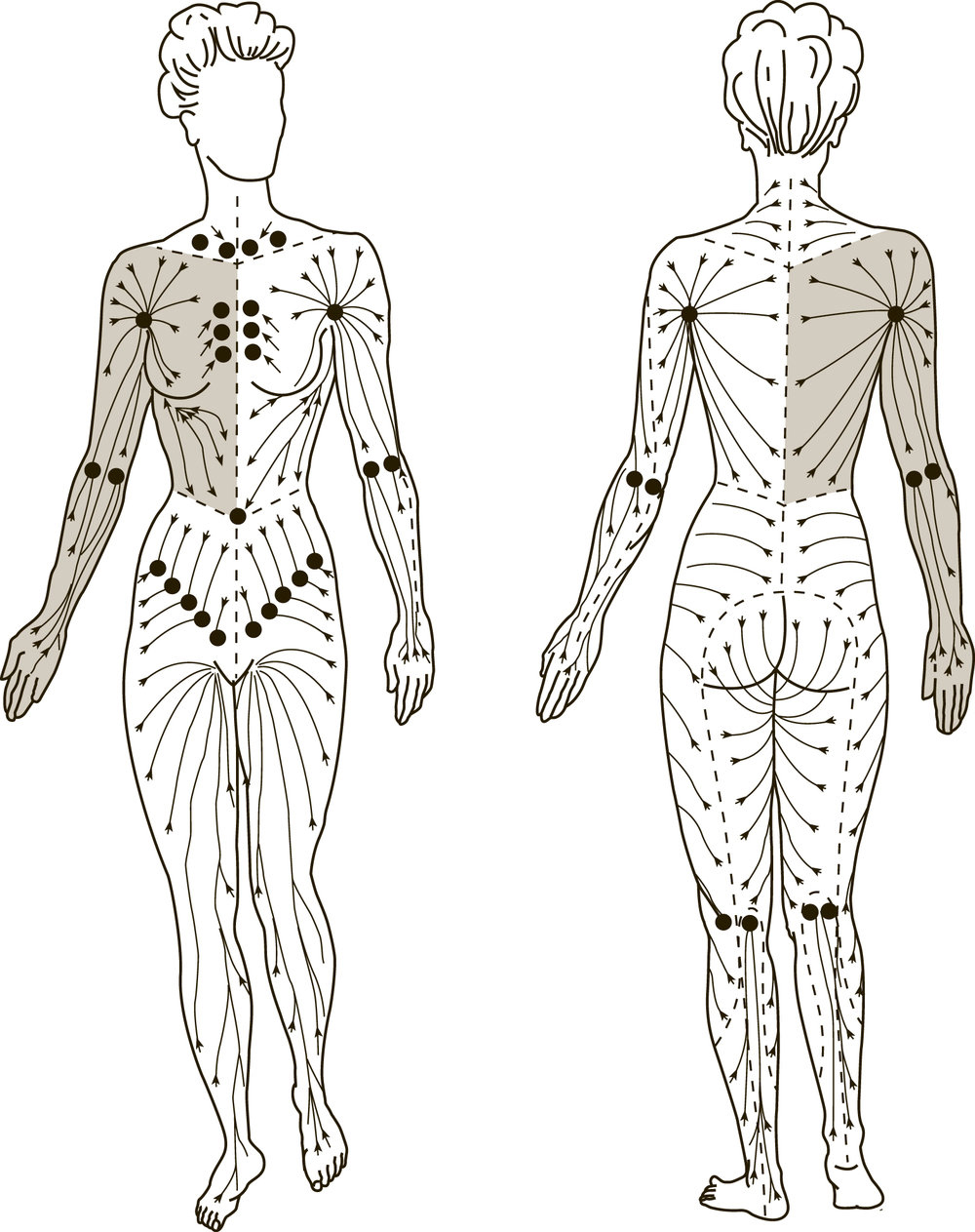
MLD stands for Manual Lymphatic Drainage. As per a deep tissue massage, MLD treatment works on the lymphatic system and not the musculoskeletal system. This technique aims to boost the capacity and ability of the lymphatic system. Manual Lymphatic Drainage history. MLD is a technique implemented by Dr Vodder and his wife, Estrid Vodder, with the help of many other scientists and researchers. Dr Vodder can be described as a visionary of the lymphatic system role. He dedicates his life to the realisation of this technique. Dr Vodder and his wife formulated a series of hypotheses on how the lymphatic system works, and how it is essential to speed up recovery from diverse conditions. All their hypothesis, along the 20th century, were then confirmed and transformed in theory thanks to the works of many other scientists. As per result, after their first few years of hypothesis formulation, in the early 20th century, they could start promoting their work and run seminars and classes about MLD all around Europe. Nowadays, is in Austria in the village of Walchsee -Tyrol -Austria resides the Dr Vodder Academy –Lymphedema Clinic Wittlinger. The Austrian clinic was founded in 1971, and since that, the MLD spread all around the world, with courses that are taught in any continent. The Lymphatic System. To understand the importance of this technique, let’s analyse the body’s anatomy and the lymphatic system’s role. Indeed, for doing so, let’s compare the lymphatic system with the blood circulatory system. Firstly, the lymphatic system is an open system of “capillaries” (lymph vessels) and “veins” (pre-collector and collectors). Secondly, It differs from the blood circulatory system as it transports lymph, not blood, and is open and not closed. Thirdly, the lymphatic system doesn’t have a pump, as is the heart for the circulatory system. In fact, the lymphatic system, pushes the lymph around through a mechanism of osmosis pressure (at the lymph vessels system) and throughout an inner system of inner valves. Furthermore, the lymphatic system has filtering stations: lymph nodes. It is here where specific white cells live. Indeed, the role of the white cells is to help fight back infections carried by viruses and bacteria. Said so, the lymphatic system’s primary role is to collect waste. This happens at two different levels. At the superficial level (80%), where the lymph vessels are (lower dermis and the superficial zone of the subcutaneous tissue) and deep level of the body (20% below the deep fascia) return this waste to the blood system will then direct all the waste to the organs that clean the body, such as liver, kidney etc. How the lymphatic system works. So, our body is covered in skin, right? Below the skin, before the fascia and muscle layers, we got lymph vessels (the equivalent of capillary for the blood system). The lymph vessel spread on a vertical level all along the body in different concentrations. As per role, the lymph vessel collects the Lymph-obligatory load, the waste and excess material the body doesn’t need. Lymph-obligatory load is made from water, protein, lipids, exogenous substances, cells etc… The collection of the lymph-obligatory load comes through a suction and osmosis approach. The lymph obligatory load travels down to the pre-collectors from the lymph vessel. Indeed, pre-collectors are slightly more significant than the lymph vessel Furthermore, rather than spread along the undersurface of the skin, they travel deep down and pass the lymph fluid to the collectors. As per result, the collectors that interconnect the lymph nodes transport the lymph-obligatory load to the blood circulatory system. Another specification to look for is that the lymphatic system is divided into superficial and deep. But we will look at this specification in the next blog post, where we will also talk about the watershed and body quadrant. Manual Lymphatic Drainage compared to the massage technique. So, now that we have a better idea of what the lymphatic system is and how it works, we can say that massage techniques such as Myotherapy, Thai Massage, Remedial Massage, or even Relaxation Massage are not the most indicated for helping the lymphatic system. They still would improve its work, but as the lymphatic system sits right below the skin and works by light stimulation, the friction and pressure applied with these techniques would be too strong. Even though no damage occurs to the lymphatic system when significant pressure is applied to it.
Functional test and the empty can test. What is a functional test? What is an empty can test and how does it work? Firstly, functional tests are used to test the strength or load capacity of a single muscle. Secondly, the importance of a functional test is due to avoid misinterpretation of the muscle status and joint health conditions. Furthermore, functional tests can be positive or negative. So, for positive, we refer to a test that gave us the result we were suspicious of. For example, if I do an empty can test, and the client during the test complains of pain in the shoulder acromion, the test is positive. But if for instance, the client complains of pain in another area of the shoulder or arm, the test is negative. Even so, as a therapist, we are aware that other area of the arm or shoulder needs to be looked after. What is an “empty can test”? An “empty can test” is a functional test used to validate the state of health of the supraspinatus tendon, at the high of the acromioclavicular joint. In addition, to better understand how this specific test works, let’s look in too the anatomy of the Supraspinatus m. Origin: Supraspinatus fossa of scapula Insertion: Greater tubercle of the humerus Action: Abduct the shoulder and stabilise the humeral head in the glenoid cavity. As per result, the action of the supraspinatus is to laterally elevate the arm and hold in place the humeral head (the Humerus is the bond of the upper arm). Furthermore, the supraspinatus is one of the rotator cuff muscles. The rotator cuff muscles are: Supraspinatus, Teres minor, Infraspinatus and subscapularis. But let’s get back to the empty can test. The empty can test can be done from seated or standing. In addition, the test is conducted in 2 different stages. Initially, we will ask the client to bring the arm in flexion at about 45° and in abduction at 45°. The arm now is sitting aside from the client’s body, on a diagonal line. Now will ask the client to rotate the arm on itself, as if they are emptying a can. As per the result, if at this stage of the functional tests, the client feels pain in the shoulder at the acromioclavicular joint, the test is positive. If that’s not the case, then we can proceed with the resistant part. If this post is talking to you, and you are in need of a massage, book your next session by clicking here. The resistant part consists of placing our hand on the client’s forearm and asking the client to meet the resistance, at 3 different stages. For each stage, the resistance increases and lasts from 3 to 5 seconds. If during any of the 3 stages the client feels pain, at the high of the acromioclavicular joint, the test is positive. But why the client can feel pain during this type of functional test? To answer this question, we have to look in too the acromioclavicular joint anatomy, but I will talk about this topic in the next blog post.