Tag Archives: MLD

The importance of Manual Lymphatic Drainage

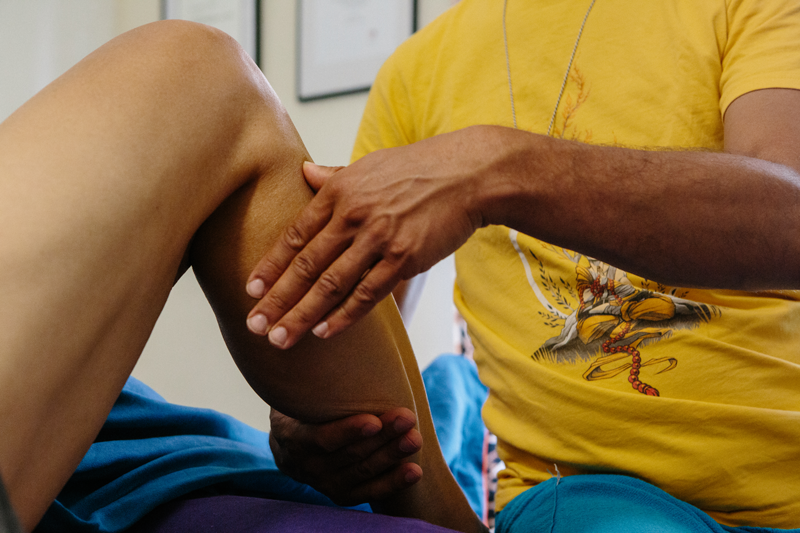
Giovanni giving MLD on patient's calf

Manual Lymphatic Drainage if used along the correct type of condition, is a safe and well utile manual therapy. In the previous two blogs (Link 1, Link 2) I described how the Lymphatic System works and its relation to MLD. What body find benefit from Manual Lymphatic Drainage? As previously mentioned, the lymphatic system is so important to keep the homoeostasis of the body. Indeed, along with the following conditions, homoeostasis is compromised: Skin Burn Chronic Inflammation (plantar fascitis, tendinitis…) Lymphodema Oedema Scar reduction and prevention Pre and post-operation body rehabilitation Improving the bell function Head-each Skin puffiness and or Acne and more… How can Manual Lymphatic Drainage help with these conditions? Firstly, what all those conditions have in common, is that they are related to how the Lymphatic System deal with them. So again, the healthier and more vital is the lymphatic system, the better the body’s homoeostasis. If we look into oedema due to a hammered hand, we need a responsive and well-functioning lymphatic system to absorb that swelling. The stronger the lymphatic system, the quicker the healing process will be. Even a scar from a post-operation could heal faster if the lymphatic system gets adequately stimulated. More nutrients and less dangerous components will float around the wound if the lymphatic system works stronger. Secondly, some of these conditions are so painful that a massage is not applicable. As we applied MLD, we would not increase the pain, thanks to the light touch. If this post is talking to you, and you need a massage, book your next session by clicking here. Why should MLD not be painful? When we apply the different strokes by dragging the skin gently around, we will stimulate the lymph vessels to collect the obligatory lymph load. Still, we will not generate pain by stimulating pain receptors. Furthermore, the repetitive mechanical stimulation would activate what in science is called the gate theory. The gate theory looks into the interneurons’ inhibitory response, which reduces the pain signal reaching the brain, consequently decreasing the pain response. MLD and coontroindications. MLD can’t be applied to Acute infection, Untreated Cancers, Untreated Thrombus, Congestive heart failure, or intoxicated persons. Minor contraindications include Hypertension/Diabetes n1, Autoimmune disease, Asthma, Hypo/Hyperthyroidism, pregnancy, and a history of tuberculosis. In conclusion, I am honoured to have the knowledge and the skill to use and apply such a technique. Even though, for now, I can’t yet treat people with Lymphodema and or clients who had lymph nodes removed or are looking for a post-cancer treatment. What I got to offer to this patient, anyway, is a reference for other practitioners. So if this is you, please get in touch with me, and I can refer you to your nearest practitioner.      

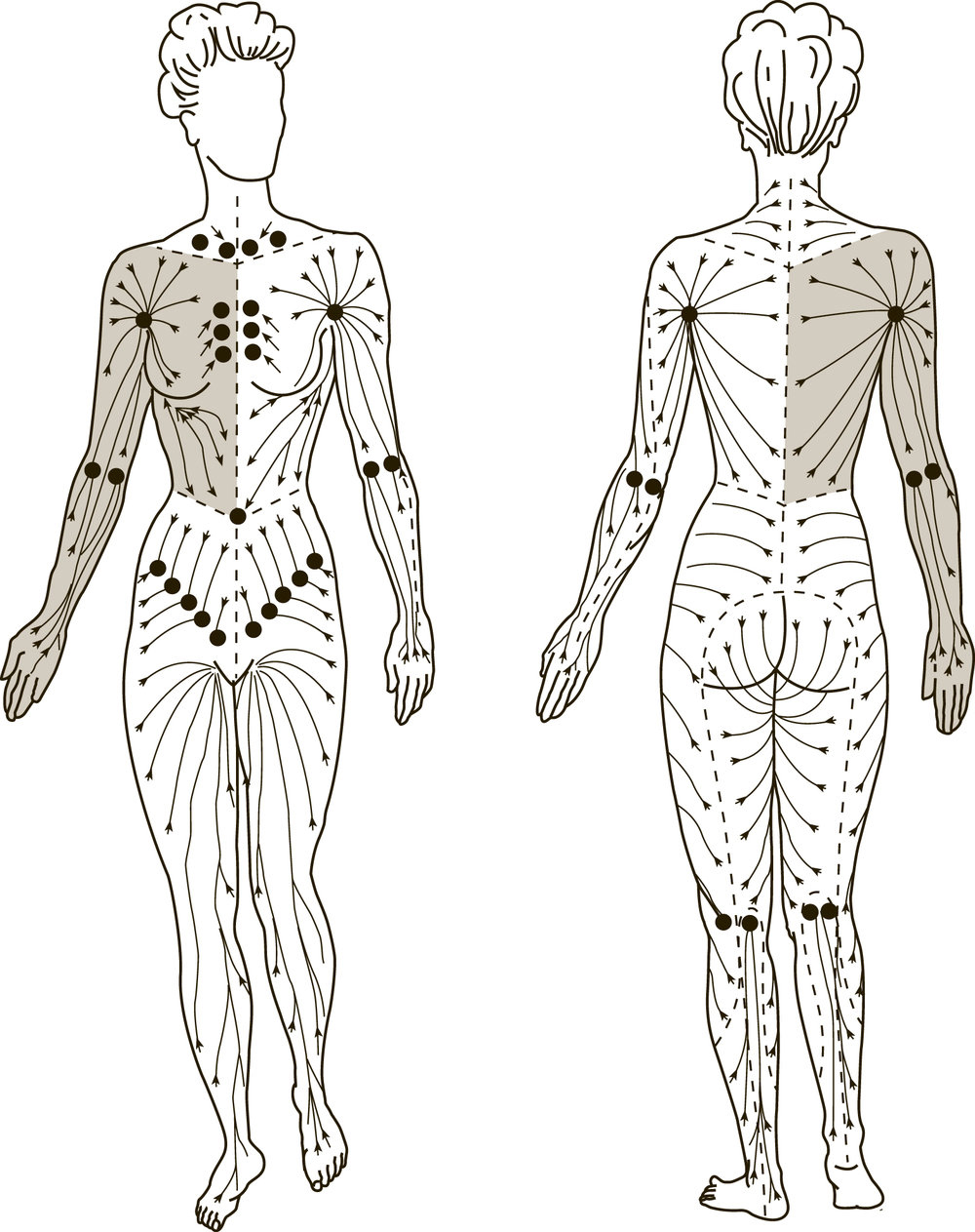
Watersheds and Body Quadrant in MLD

watersheds quadrant

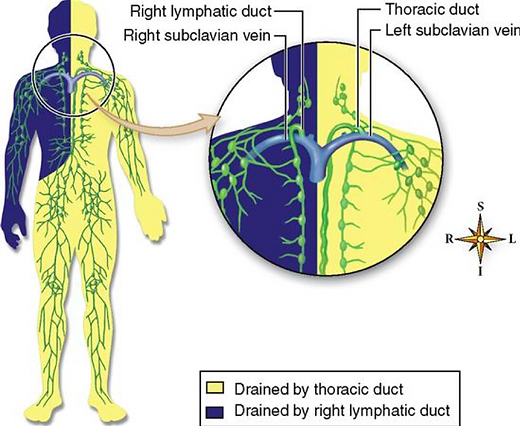
A Watershed is an imaginary line that divides the body and the Lymphatic System into quadrants. Each quadrant has its lymphatic liquid collection canal, and the lower quadrants, as per the two legs, sends the liquid to the cisterna kili, a gland that sits deep behind the belly button that is connected to the upper left duct within the upper left quadrant. Some genetic variation, seeing the thoracic duct connecting to the right lymphatic duct. What does the watershed division look like? The main watersheds are four. A vertical one divides the body into two equal vertical halves. A horizontal one divides the body into the upper and lower body at the inguinal level. Other horizontal watersheds are parallel to each other and are located at: The clavicle line runs through the belly button on top of the iliac crest. In doing so, we have six quadrants: upper, medial, and lower. Other watersheds run vertically within the body. Those are located on the arms and on the upper leg. The importance of watersheds. As we dig more and more within the functionality of the Lymphatic System and MLD as a Lymphatic Drainage technique, we can see that in these specific quadrants, there are bundles of Lymph nodes that get loaded from the lymph vessels connected to them. The watershed division allows the liquid to be directed to a specific body area where lymph nodes are found. Indeed, the lymph nodes are the ones that clean up the lymph fluid, also called obligatory lymph load. When we treat a patient, we have to make sure where we direct the liquid because we want to ensure that the lymph fluid gets sent to the lymph nodes, where it will be processed and then transferred to the lymph/vein duct at the base of the cervical area. This is extremely important when we treat Lymphoedema, where we may bypass the watersheds, where the lymphatic system has been damaged or is missing, to transport the lymphatic fluid from a stagnant area to an active one. How to bypass a watershed To bypass a watershed and transfer the lymphatic fluid from one side of the body to the other side, we have to stimulate the anastomoses, which are the alternative pathways of the lymphatic system. Unless those pathways are stimulated, we can not transfer the fluid side to side along the horizontal or vertical lines. An example would be a person who went through a mastectomy and has a unilateral Lymphoedema. In that case, we need to stimulate the upper anastomosis to transfer the fluid side to side. In the drawing beside, you can notice the upper anterior and posterior anatomoses drawn in thick green lines. The upper watershed and the duct. After the obligatory lymph load reaches the upper watershed (the one running along the clavicle), it gets passed to the venous system. This happens after the obligatory lymph load travels with the trunk collector and passes through the duct. The duct is the last portion of the lymph trunk that connects to the venous system. In conclusion, we want to specify that the lower quadrants (R leg and L leg) and the upper L quadrant drain in the L thoracic duct within the L subclavian vein. Where the R upper quadrant drains into the R duct connected to the R subclavian vein. Below here, is a list of blog posts that talk about conditions where MLD can be beneficial: Bone fracture Sunburn Preeclampsia TMJ Chronic Pain Fibromyalgia Melbourne Massage and Treatment and Lymphatic Drainage Massage At Melbourne Massage and Treatment, Lymphoedema Clinic, I am specialised in Applied MLD and Lymphoedema management. I did train with the Vodder academy for my Lymphatic Drainage practice, and I have a clinical approach to this type of work. If you are in need of manual lymphatic drainage treatment, do not hesitate to book your next appointment now. A 15-minute Online free consultation is also available for those who suffer from Lymphoedema or Lipedema.

MLD

MLD

MLD stands for Manual Lymphatic Drainage. As per a deep tissue massage, MLD treatment works on the lymphatic system and not the musculoskeletal system. This technique aims to boost the capacity and ability of the lymphatic system. Manual Lymphatic Drainage history. MLD is a technique implemented by Dr Vodder and his wife, Estrid Vodder, with the help of many other scientists and researchers. Dr Vodder can be described as a visionary of the lymphatic system role. He dedicates his life to the realisation of this technique. Dr Vodder and his wife formulated a series of hypotheses on how the lymphatic system works, and how it is essential to speed up recovery from diverse conditions. All their hypothesis, along the 20th century, were then confirmed and transformed in theory thanks to the works of many other scientists. As per result, after their first few years of hypothesis formulation, in the early 20th century, they could start promoting their work and run seminars and classes about MLD all around Europe. Nowadays, is in Austria in the village of Walchsee -Tyrol -Austria resides the Dr Vodder Academy –Lymphedema Clinic Wittlinger. The Austrian clinic was founded in 1971, and since that, the MLD spread all around the world, with courses that are taught in any continent. The Lymphatic System. To understand the importance of this technique, let’s analyse the body’s anatomy and the lymphatic system’s role. Indeed, for doing so, let’s compare the lymphatic system with the blood circulatory system. Firstly, the lymphatic system is an open system of “capillaries” (lymph vessels) and “veins” (pre-collector and collectors). Secondly, It differs from the blood circulatory system as it transports lymph, not blood, and is open and not closed. Thirdly, the lymphatic system doesn’t have a pump, as is the heart for the circulatory system. In fact, the lymphatic system, pushes the lymph around through a mechanism of osmosis pressure (at the lymph vessels system) and throughout an inner system of inner valves. Furthermore, the lymphatic system has filtering stations: lymph nodes. It is here where specific white cells live. Indeed, the role of the white cells is to help fight back infections carried by viruses and bacteria. Said so, the lymphatic system’s primary role is to collect waste. This happens at two different levels. At the superficial level (80%), where the lymph vessels are (lower dermis and the superficial zone of the subcutaneous tissue) and deep level of the body (20% below the deep fascia) return this waste to the blood system will then direct all the waste to the organs that clean the body, such as liver, kidney etc. How the lymphatic system works. So, our body is covered in skin, right? Below the skin, before the fascia and muscle layers, we got lymph vessels (the equivalent of capillary for the blood system). The lymph vessel spread on a vertical level all along the body in different concentrations. As per role, the lymph vessel collects the Lymph-obligatory load, the waste and excess material the body doesn’t need. Lymph-obligatory load is made from water, protein, lipids, exogenous substances, cells etc… The collection of the lymph-obligatory load comes through a suction and osmosis approach. The lymph obligatory load travels down to the pre-collectors from the lymph vessel. Indeed, pre-collectors are slightly more significant than the lymph vessel Furthermore,  rather than spread along the undersurface of the skin, they travel deep down and pass the lymph fluid to the collectors. As per result, the collectors that interconnect the lymph nodes transport the lymph-obligatory load to the blood circulatory system. Another specification to look for is that the lymphatic system is divided into superficial and deep. But we will look at this specification in the next blog post, where we will also talk about the watershed and body quadrant. Manual Lymphatic Drainage compared to the massage technique. So, now that we have a better idea of what the lymphatic system is and how it works, we can say that massage techniques such as Myotherapy, Thai Massage, Remedial Massage, or even Relaxation Massage are not the most indicated for helping the lymphatic system. They still would improve its work, but as the lymphatic system sits right below the skin and works by light stimulation, the friction and pressure applied with these techniques would be too strong. Even though no damage occurs to the lymphatic system when significant pressure is applied to it.
Lower Back Pain

lower back pain

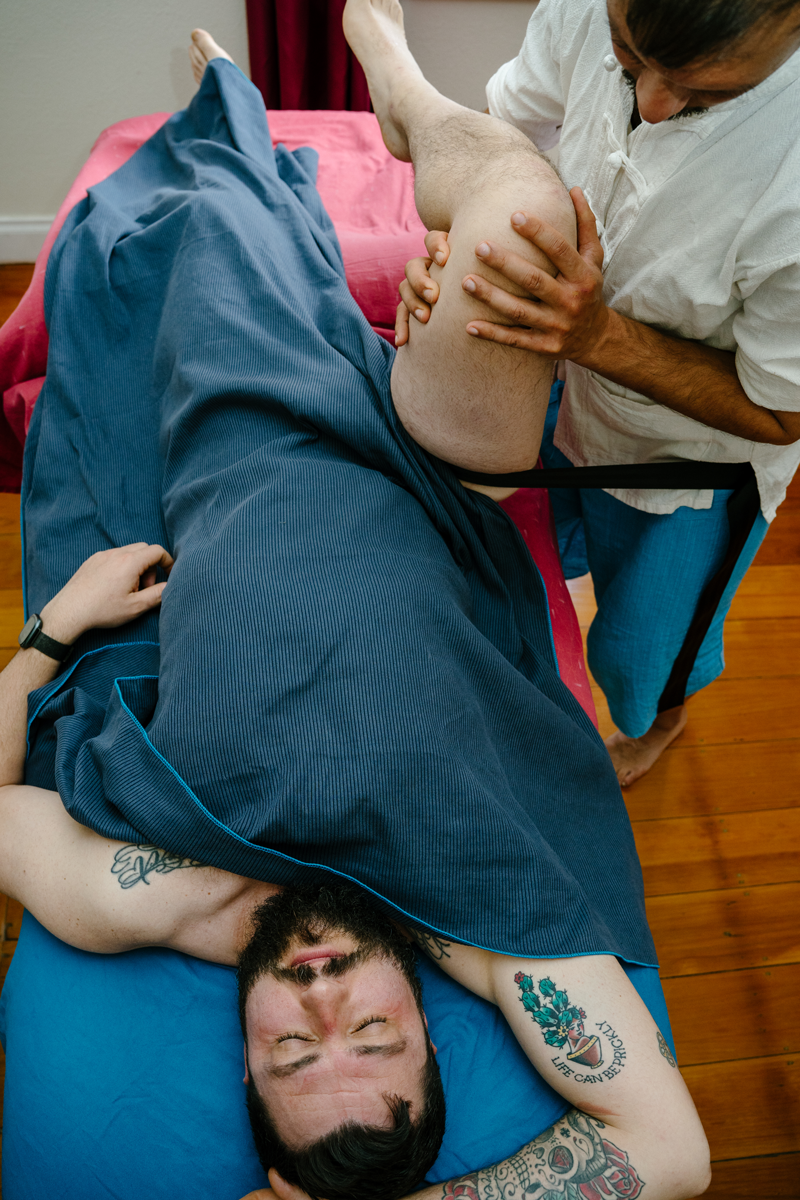
Lower Back Pain Lower back pain is a condition which can deliver lots of stress and can affect our daily habits. It can be a terrible experience to live, as it can make many tasks difficult or impossible to take. Here below you will find a series of questions and answers in regard to my experience with lower back pain, as a person and as a practitioner. Q: Did/do you ever experience lower back pain? A: Yes, I did suffer from lower back pain when I was a teenager and that was a trigger for my massage career.Said so, at the age of 16, I was not thinking yet to become a massage therapist.More experience was needed before I did decide to step into the massage career. Q: How common is lower back pain within the Australian population? A: It is estimated that in Australia between 2017 and 2018 4.0 million people did suffer from back pain, whereas 70-90% out of those 4 million did suffer from the lower back itself. Q: What are the causes of Lower back pain? A: Lower back pain can come from different causes. Here below are the most common: bulge disk muscle strain fascia tightness trigger points muscular-skeletal unbalance physical trauma stress Q: I feel pain on my Rx or Lx side on a horizontal line. What can be? A: That’s what we call a red flag. A pain that spread on a horizontal line can be given by a bulging disk. More tests must be put in place to confirm a diagnosis. As a massage therapist is not in our scope of practice to diagnose a bulging disk. Our next step would be to refer you to a GP for further investigations. Q: So, what is a bulging disk? A: A bulging disk is a condition (hernia) where the disk that seat between the vertebrae, gets a tear in it. As a consequence, the disk touches the nerve running along the spine and creates a pain sensation. There are 4 different stages of herniation of the disk. Disc protrusion Prolapsed disc Disc extrusion Sequestered disc. Q: What are other symptoms related to a bulging disk (for the lower back)? A: Other symptoms of a bulging disk (for the lower back) can be: Numbness in the glutes, legs, feet. Weakness in the leg/feet movement Pain increases when seating, like the disk, gets compressed and decreases if standing, like the disk, gets decompressed and less pressure is applied to the nerve root. Difficulties in going to urinate, it is a strong sign that there could be a bulging disk in the lower side of the lumbar area. Medical attention is urgently recommended. Q: Why a bulging disk can occur urine blockage? A: The nerve that controls the spasm of the bladder is rooted between L1 and L2. Indeed, Pressure on the main root, between these 2 vertebrae, would then transform into nerve dysfunction. This condition is called Cauda Equina Syndrome. Q: My lower back pain moves vertically. Why is that? A: A sign of lower back pain that moves vertically is more luckily related to muscular inflammation. In fact, there is a group of back muscle called Erectus Spinae, (Spinalis, Longissimus, Illiocostalis) that originates in the lower side of the lumbar area and extend vertically along the cervical area. Q: What triggers muscle inflammation? A: Many are the reason why muscles can get inflamed.Repetitive movements pour posture, the incorrect firing pattern of a muscle group, in specific the leg extension firing pattern. Q: How massage can help? A: Massage can be an effective approach to release tension along the lower back. Given the training that I did go for, I would ensure to use the knowledge learned along the Remedial Massage and Myotherapy course to identify what back pain is related to. Based on the finding and on the willingness of the clients, we can then disgust with the client what technique of massage they may prefer, Remedial Massage, Dry Needling (if applicable), Mobilisation (if applicable) or Thai Massage. Even MLD can be an effective technique, as it can be used to reduce inflammation, swelling, tension and stress. As previously mentioned, if I got suspicious of a bulging disk, I would not hesitate to refer the client to a GP for further investigation. In regards to the Thai massage technique, I will ensure to warm up the area first with some simple passives stretch and or cupping and then work on the muscle that needs some tension released if it is safe to do so, or on the muscle surrounding the area, like gluteus, hamstrings and or shoulder muscles. Q: Would you use your knee to massage my back? A: The use of the knee is not compulsory. If it is safe to do so, yes, I may use my knee to massage the back. A correct and proper evaluation of the injury must be applied before doing so. If you are in pain or even just feel tight along your lower back, don’t hesitate to book a massage appointment. Any of the techniques offered at Melbourne Thai Treatment can be really effective in reducing pain and ache and giving you back the mobility lost. Said so, for chronic conditions their massage can help till a certain point. Exercises and other treatment options have to be evaluated.

The Importance of Breathing

lungs

The importance of breathing. As a massage therapist, I realise along with my studies and work-practice, that correct breathing is not something that many of us are aware of. Indeed, breathing is important to oxygenate our organs, muscle and all body parts and also, breathing is what would boost the healing process along a massage session. In fact, when we breathe, we introduce into the body Oxygen. Oxygen is what our body uses as the first form of energy for functioning and self-healing. Furthermore along with oxygen, when we breathe, there are a lot of other substances that get pumped around the body with the blood, like vitamins, minerals, hormones etc. So how should we breathe, during a massage session? To breathe we can mainly use the noose and the mouth. By breathing by the nose we partly clean the air that we take in, things that wouldn’t happen when we breathe in by the mouth, as we would breathe whatever is in the air. If this post is talking to you, and you are in need of a massage, book your next session by clicking here. But that’s all? No. Air inhaled through the nose is both warmed and made moist at the same time, but also preserves oral hygiene. Furthermore, breathing in with the nose is a slower process and helps the mind to stay calm and grounded. Breath-in by the mouth can lead to hyperventilation, that’s a cause of stress and or a response to panic and anxiety. The mouth is part of the body that we should use to breathe out. As we breathe out we want to let go of all the air that we inhale without interruption. So, a better way of breathing would be, to breathe in through the nose and out of the mouth. But where into inhaling the air that we breathe? This is a question that we will see in the next blog post that would talk about the breathing wave exercise, an essential technique to calm down the mind, regulate blood flow and stimulate the relaxation of the nervous system.


This will close in 0 seconds


This will close in 0 seconds


This will close in 0 seconds